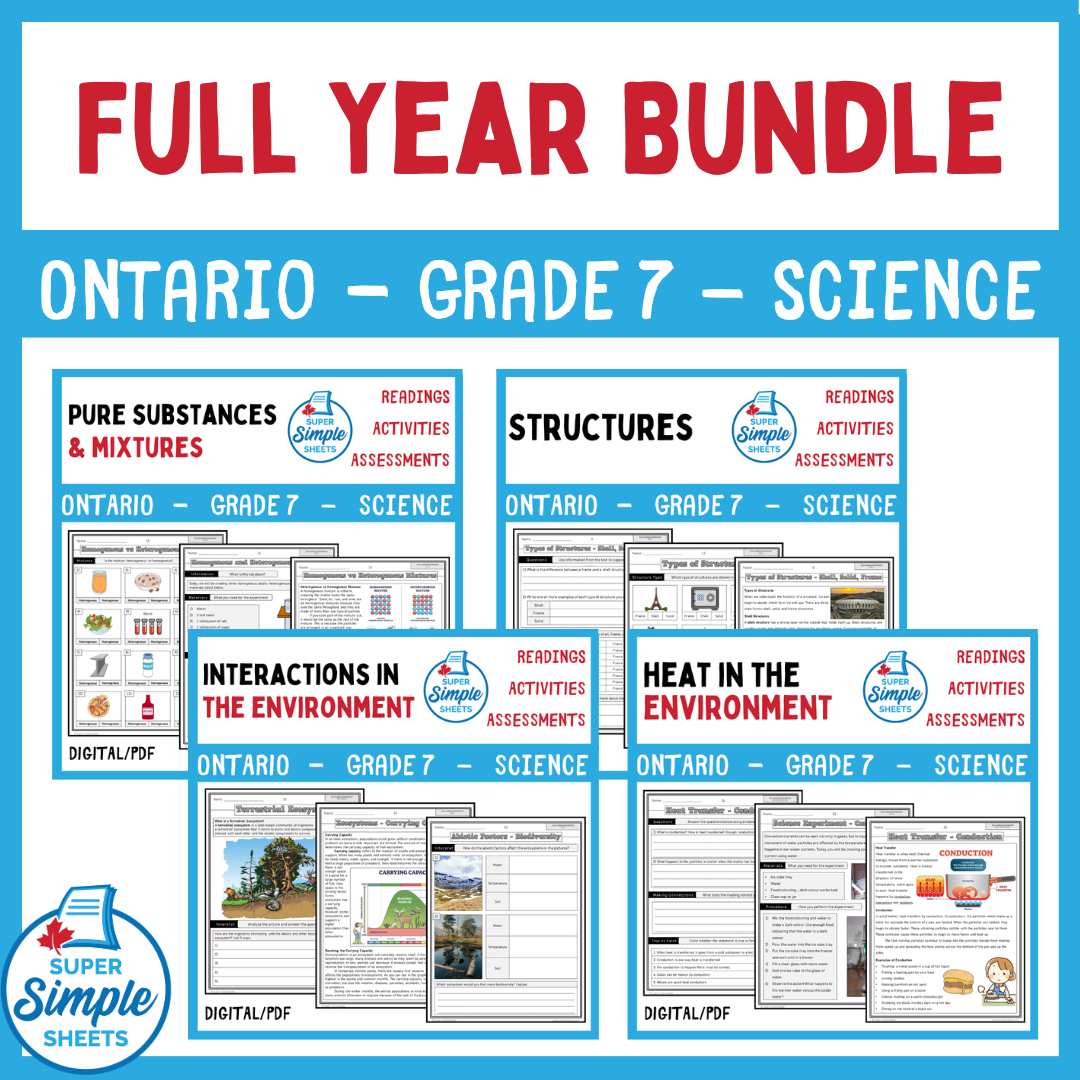


Grade 7 - Ontario Science STEM - Full Year Bundle - Updated in 2026
Grade 7 - Ontario Science STEM - Full Year Bundle - Updated in 2026
Interested in a bundle? Shop below instead!
Couldn't load pickup availability
Grade 7 - Ontario Science STEM - Full Year Bundle - Updated in 2026
New Ontario Science Curriculum - Grade 7 – This product was created to cover all of the expectations in the Grade 7 Science Curriculum.
***Strand A: STEM/Coding has been added to this unit at no extra charge!
There are 650+ activities sheets that cover the expectations in the new science curriculum. This massive unit contains readings, research assignments, diagrams, true/false, and much more!
Most importantly, we have made cross-curriculum connections to the grade 7 language program. Students will practice reading comprehension strategies (making connections, summarizing, visualizing, and questioning) as they work through this unit.
DIGITAL AND PDF VERSIONS BOTH INCLUDED!
Check out the previews of these units to learn more about how it can benefit your students in science and language!
Life Systems: Interactions in the Environment (NEW 2022 Curriculum!)
Some of the concepts that are covered:
- Ecosystems
- Terrestrial Ecosystem
- Aquatic Ecosystem
- Living Things – Basic Needs
- Biotic Factors in Forests
- Abiotic Factors in Forests
- What is Biodiversity?
- Abiotic Factors & Abiotic Factor Biodiversity
- STEAM – Designing a Zoo Enclosure
- Food Chain – Producers and Consumers
- Nutrient Cycle – Food Chain
- Decomposers and Detritivores
- Research - Scavengers
- Altering the Food Chain
- Overfishing – Effects on Food Chain
- Sustainability – Cycle of Matter
- Sustainability – Crop Rotation
- Invasive Species in Ontario
- Activity – The Sports Field Debate
- Ecological Succession
- Primary & Succession Diagram
- Predicting The Future of Ecosystems
- Ecosystems – Biotic and Abiotic Limiting Factors
- Ecosystems – Carrying Capacity
- International Trade – Introducing Invasive Species
- Human Use of Forests – Past and Present
- Agriculture – Clearcutting Forests
- Deforestation Statistics – Infographic Activity
- Livestock Farming – Effects on Ecosystems
- Sustainable Livestock Practices
- Locally Grown Food
- Pesticides Affecting Ecosystems
- Technological Advancements Helping Ecosystems
- Effects of Vehicles on The Environment
- Indigenous Groups and The Environment
- Indigenous Practices Promoting Sustainability
- Seventh Generation – Indigenous Teaching Sustainability
- Anishinabek/Ontario Resource Management Council
- Technology in Zoos
- Unit test
- Answer pages for all activities
Form, Function and Design of Structures (NEW 2022 Curriculum!)
Some of the concepts that are covered:
- Types of structures: shell structures, frame structures, and solid structures
- Centre of gravity affecting a structure’s stability
- Leaning Tower of Pisa – How the centre of gravity is affecting its stability
- Evaluating the stability of structures by determining the centre of gravity
- Centre of gravity experiments
- Internal forces – shear, compression, tension, and torsion affecting structures
- Finding examples of these internal forces in our environment
- External forces from the natural environment – natural forces (earthquakes, tsunamis, etc.)
- The Tacoma Narrows Bridge – how external and internal forces caused the collapse
- Live and dead loads
- Describing forces – Magnitude, direction, point of application and plane of application
- Magnitude – Force diagrams using arrows
- Determining the net force by reading force diagrams and arrows
- Spring scales and beam balance scales – experiment and reading/questions
- Mechanical advantages using Newtons
- Symmetrical structures creating stability
- Evaluating the symmetry of structures and their stability
- Structural failures – poor foundations, bad designs, faulty construction and extraordinary loads
- Digging foundations below the frost line – Basements
- Leaning Tower of Pisa and its poor foundation – foundation settling
- Examining bad designs in structures around the world
- Extraordinary loads – Ice Storm 1998
- Faulty construction leading to structural failures – Skyline Plaza Apartment Building collapse
- Properties of materials – cement, steel, rubber and plastic
- Choosing the right building material – manufacturing shoes
- Ergonomics in structures – office equipment and tools
- Assignment – creating an ergonomic workstation
- Structural analysis – engineers and architects researching the forces and loads acting on potential structures
- Structural assessment reports – engineers working to keep structures safe
- STEM Activities
- Hands on Experiments – building bridges, chairs, tower
- Artificial intelligence on construction sites keeping them safe
- Coding – Monitoring the Leaning Tower of Pisa
- Reading and writing code
- STEM Assignment – AI improving safety at recess
- Unit test
- Answer pages for all activities
Pure Substances and Mixtures (NEW 2022 Curriculum!)
Some of the concepts that are covered:
- Particle theory of matter
- Atoms and molecules
- Pure substances – compounds and elements
- Mixtures and pure substances
- Homogenous mixtures and heterogenous mixtures
- Classifying atoms, molecules, compounds and elements
- Classifying mixtures and pure substances
- Classifying homogenous and heterogenous mixtures
- Science experiment – homogenous and heterogenous mixtures
- Mechanical mixtures and solutions
- Saturation – saturated solutions, unsaturated solutions, and supersaturated solutions
- Solutes, solvents, and solutions
- Water – the universal solution
- Science experiment – testing the dissolving process
- Factors affecting solubility
- Describing solutions – concentration and dilution of solutions
- Describing the concentration of solutions – in quantitative and qualitative terms
- Kinetic energy – particle theory in solutions
- Heterogenous suspensions, heterogenous emulsions, and heterogenous colloids
- Separating mixtures – chromatography, evaporation, filtration, and magnetism
- Separating mixtures – distillation diagram
- Research assignment – researching separation methods
- Science experiment – making a crystal (evaporation separation method)
- Mixtures that produce carbon dioxide
- Environmental effects of using pure substances – mining and refining
- Research assignment – uranium pure substance
- Refining oil – fractional distillation method
- Research assignment – researching oil refineries
- Impact of separating mixtures – maple syrup
- STEM Activities
- Hands on Experiments – emulsions, making a crystal, testing the dissolving process, separating mixtures
- Reading and writing code
- Chemistry and automation – artificial intelligence
- STEM Assignment – making cough medicine using coding
- Unit test
- Answer pages for all activities
Heat in the Environment (NEW 2022 Curriculum!)
Some of the concepts that are covered:
- What is Thermal Energy?
- The Particle Theory of Matter
- Heat Transfer and The Particle Theory
- Changes in State – Physical Changes Involving Heat
- Melting and Freezing
- How Heat is Generated
- Thermal Energy From The Sun
- Effects of Heat on States of Matter
- Heat vs Temperature
- Thermal Expansion and Contraction
- Convection, Conduction, Radiation
- Heat Transfer - Conduction
- Thermal Conductivity
- Heat Transfer - Convection
- Convection – Sea vs Land Breeze
- Heat Transfer - Radiation
- Electromagnetic Radiation
- Ocean Currents and Climate
- The Sun and The Water Cycle
- The Atmosphere
- Energy From the Sun - Albedo
- Producing Carbon Dioxide
- Greenhouse Gas Effect
- Greenhouse Gases – Carbon Dioxide
- Greenhouse Gas Emissions by Country
- Carbon Capture Technologies
- Solar Energy
- Wind Energy
- Hydro Energy
- Using Energy – Effect on Environment
- Heating our Homes – Renewable/Non-Renewable Energy
- Geothermal Energy
- Coding - Thermostat
- Nuclear Power
- Nuclear Power Accidents
- Refining Oil
- Oil Spills
- Energy Efficient Homes
- Net Zero Homes
- Heat Dissipation During Energy Transfer
- Unit test
- Answer pages for all activities
This is a comprehensive bundle that will save you hours of planning! It has been tested and found effective in helping students achieve the learning goals in the science curriculum.