
Grade 2 - Saskatchewan Language - Lessons/Workbook Mega Bundle
Grade 2 - Saskatchewan Language - Lessons/Workbook Mega Bundle
Interested in a bundle? Shop below instead!
Couldn't load pickup availability
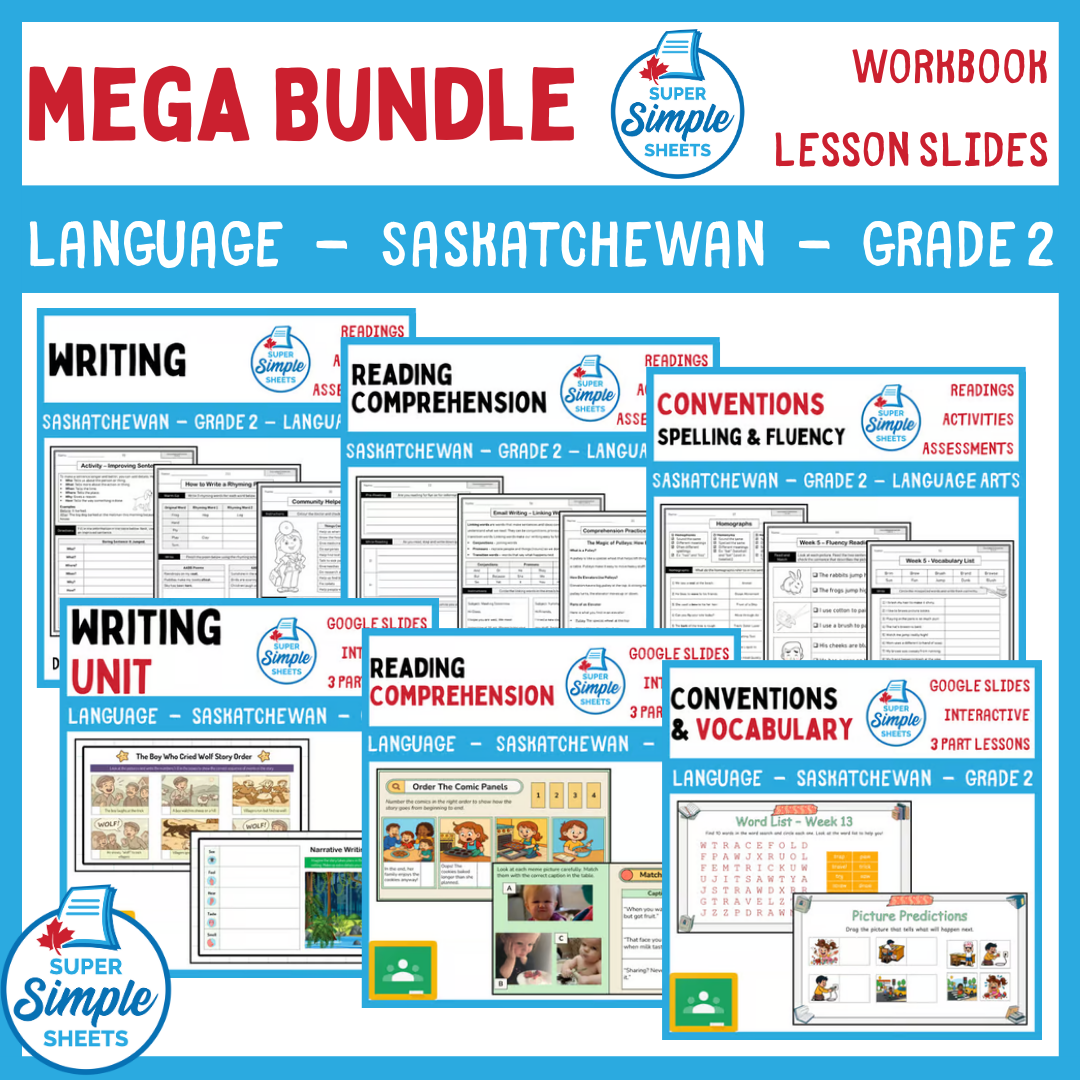
This mega bundle provides everything you need to teach all the units in the Grade 2 Saskatchewan Language Curriculum.
With your purchase, you will receive lesson slides that follow the 3-Part lesson format, engaging your students from start to finish. You will also receive the workbooks, which contain fun activities and worksheets for your students to demonstrate their understanding.
Writing Unit
Workbook
Some of the concepts that are covered:
- Types of text forms – when to use each one (narratives, letters/emails, procedural writing, reports, etc.)
- Experiment – writing with planning time versus writing without planning time (no brainstorming)
- Personal Identity – Mapping my identity
- Community Helpers – Writing about their roles
- What is a message?
- Purpose and audience of messages
- Personal voice in writing
- How to write descriptive sentences
- Activity – nature walk descriptions
- Writing activity – my dream playground
- How to write a paragraph – topic sentence (hook), body, conclusion
- Formal versus informal letter writing – voice in our writing
- Purpose and audience in letter writing – effect on our voice
- Writing personal narratives
- Setting and character development
- Narratives with a beginning, middle, and ending
- Publishing personal narratives
- Analyzing quality stories – building success criteria
- Activity – Story Swap Revision Party
- Opinion writing – being persuasive
- Fact or fiction – which is more persuasive?
- Reconstructing texts – example: from news article to letter
- Researching – finding facts to support our opinion
- Research activity – completing a weather report
- Research – animal fact sheet
- Interviews – creating a family tree by interviewing family members
- Research – questioning: asking community members questions
- Procedural writing – instructions
- Writing instructions for simple tasks
- Sequencing the order of instructions
- Writing and publishing instructions
- Report writing – a quick guide
- Activity – Idea Factory
- Writing reports – using the facts provided to organize a report
- How to research effectively
- Activity – Online Treasure Hunt
- Types of poems – Haiku, Limerick, Rhyming, and Acrostic Poetry
- Illustrating a poetry children’s book
- Writing book reviews
- Summarizing books for our book reviews
- Printing practice: 16-page package
- Answer pages for all activities
Reading Comprehension Unit
Workbook
Some of the concepts that are covered:
- What are text forms?
- Before reading: comprehension strategies – activating prior knowledge and reasons for reading
- During reading: comprehension strategies – questioning, making connections, inferences, predictions, visualizing
- After reading: comprehension strategies – summarizing, making inferences, visualizing
- Monitoring understanding – does it look right, does it sound right, does it make sense?
- Independent reading response package – booklet
- Vocabulary to talk about texts: book, page, chapter, author, title, illustrator, headings, table of contents, etc.
- Jokes and riddles
- Letter writing – emails, formal and informal letters, writing with voice
- Cohesive ties – using linking words (conjunctions, pronouns, and transition words) in letter writing
- Narratives – use of literary devices: similes and consonance
- Perspective in narratives – first-person and third-person
- Narratives – sequencing multiple plots in a story and explaining cause and effect
- Folk tales and legends – heroes and heroines
- Comparing identities – Métis child and First Nation child
- Story structure – characters, setting, plot, and events
- Reading strategies – chunk words, stretch words, and re-read texts
- Cross-curricular connections – science and social studies (water, growth of animals, changing families, etc.)
- Persuasive writing – using critical thinking skills to determine bias
- Using facts or opinions in persuasive writing
- Finding implicit and explicit evidence in persuasive texts
- Making inferences about persuasive texts
- What is procedural writing?
- Text features and text patterns of procedural writing – instruction booklets, how-to-guides
- Sequencing the steps in a how-to-guide
- Using graphics to enhance procedural texts
- Indigenous connection: how-to-guides for drawing Totem Poles, Igloos
- Text features in reports – index, glossary, timelines, headings, table of contents, charts, icons, etc.
- Reports on diversity, inclusion, and accessibility
- Use of infographics, timelines, maps, diagrams, and pictures in reports
- Literary devices used in poetry – similes and consonance
- Acrostic poems
- Assignment – examining poems written by Indigenous authors
- Reading different styles (voices) in book reviews
- Text features in comics, infographics, memes, and maps
- How images, graphics, and visuals contribute to biographies
- Text features in biographies – using a table of contents, icons, and indexes to understand a biography
- Biographies – Albert Einstein, Terry Fox, Margaret Atwood, Stephen Hawking: Table of Contents, Glossary
- Identifying familiar and “sight” words
- Metacognitive activities: reading goals, using reading strategies reflections, tracking reading times
- Answer pages for all activities
Language Conventions and Vocabulary Unit
Workbook
Some of the concepts that are covered:
- Base Words
- Common Suffixes (e.g., -ing, -ed, -er)
- Common Prefixes (e.g., un-, re-, dis-)
- Compound Words
- Position-based Tendencies (E.G., I Before E, Q And Then U)
- Bossy E (Magic E) Concept – CVCe Spelling Pattern
- Spelling Patterns – CVCe, VCC, VVC
- Soft And Hard Sounds – C And G
- Different Letter Sound: Y As A Vowel Or Consonant
- Blending Sounds In Words That Have Up To 6 Phonemes
- Manipulating Sounds – Regular/Irregular Words (Short/Long Vowel Sounds, Silent Letters, Irregular Blends)
- Adding Phonemes, Deleting Phonemes, Substituting Phonemes To Change Words, Including Blends
- Word Families & Rhyming Words
- Commonly Misspelled Words
- Antonyms And Synonyms
- Homophones And Homographs
- Alliteration, Onomatopoeia, And Repetition
- Fact versus Fantasy
- Following Instructions by Reading Carefully
- Reading Accuracy: Words & Sentences
- Pacing In Paragraph Reading & Reading Punctuation
- Strategies For Expressive Reading Aloud
- Types Of Sentences - Interrogative, Imperative, Declarative, And Exclamatory
- Using Different Punctuation
- Parts Of Speech Overview (E.G., Nouns, Verbs, Adjectives, Prepositions)
- Subject-Verb Agreement
- Personal Pronouns: Usage And Examples
- Decoding Reading Strategies: Breaking Words Into Chunks, Visualizing, and Using Context
- Reading Strategy: Retell Activities
- Reading Strategies: Sight Words and Monitoring Spelling/Reading (does it look right, sound right, make sense?)
- Using riddles and jokes to teach language fundamentals
- Using Dictionaries to Learn Word Meanings
- Compound Sentences & Conjunctions (FANBOYS)
- Capitalization Rules (E.G., Start Of A Sentence, Proper Nouns)
- Punctuation Rules (E.G., Apostrophes, Commas In Lists, Quotation Marks)
- Fluency Readings For Each Week To Reinforce Word List Vocabulary
- Weekly Quizzes (30 Different Assessments)
- Answer Pages For All Activities
Google Lesson Slides
Grade 2 - Google Lesson Slides - Saskatchewan Language Curriculum. This resource is packed with all the lessons you need to teach the Grade 2, Saskatchewan Language Curriculum.
We have structured these lessons to follow the popular 3-Part Lesson format. By using these lessons, you will be provided with learning goals, discussion questions, relevant YouTube videos, interactive slides, exit cards, and more. Check out the variety of activities you'll receive below.
Part 1: Minds On!
- Learning Goals
- Discussion Questions
- Polls/Surveys
- Picture Prompts
- Jokes and Riddles
- Relevant Quotes
Part 2: Action!
- Interactive Activities
- Drag and Drop
- Fill in the Blanks
- Matching
- Sorting
- Polls/Surveys and Graphing
- Embedded YouTube Videos
Part 3: Consolidation
- Exit Cards
- 3-2-1 Reflections
- One Word Reflections
- Act It Out!
- Quick Draw
- One Sentence Summary
After purchasing this resource, you will be able to download copies of the Google Slides for the three different units to your Google Drive. From there, you can complete these lessons with your class, and/or assign these slides in Google Classroom.