
Grade 3 - Alberta Language - Lessons/Workbook Mega Bundle
Grade 3 - Alberta Language - Lessons/Workbook Mega Bundle
Interested in a bundle? Shop below instead!
Couldn't load pickup availability
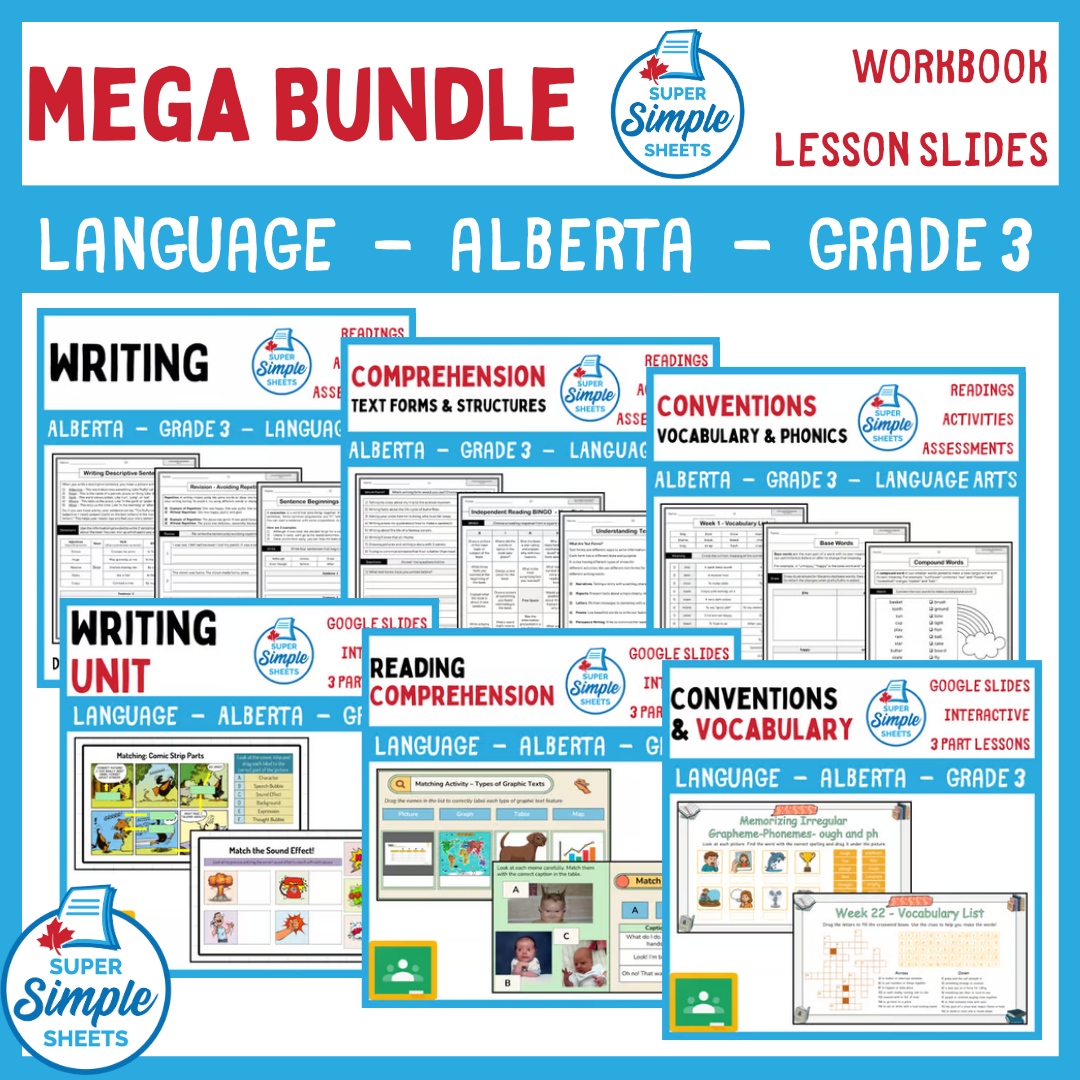
This mega bundle provides everything you need to teach all the units in the Grade 3 Alberta Language Curriculum.
With your purchase, you will receive lesson slides that follow the 3-Part lesson format, engaging your students from start to finish. You will also receive the workbooks, which contain fun activities and worksheets for your students to demonstrate their understanding.
Writing Unit
Workbook
Some of the concepts that are covered:
- Types of text forms – when to use each one (narratives, letters/emails, persuasive, comic strips, reports, etc.)
- Experiment – writing with planning time versus writing without planning time (no brainstorming)
- Sentence beginnings – using adjectives, verbs, adverbs, conjunctions, and prepositional phrases
- Writing descriptive sentences – using adjectives, verbs, adverbs and prepositions
- Revision skills – how to fix run-on sentences
- Revision skills – how to avoid repetition in writing
- Revision skills – writing fluency: ensuring our writing can be read aloud fluently
- Improving boring sentences using prepositions
- Personal voice in writing
- How to write a paragraph – topic sentence (hook), body, conclusion
- Formal versus informal letter writing – voice in our writing
- Purpose and audience in letter writing – effect on our voice
- Narrative writing – beginning, middle, end
- Analyzing quality stories – building success criteria
- How to write dialogue – using quotations and speaker tags
- Using quotations in our narratives – dialogue
- Activity – Story Swap Revision Party
- Understanding persuasive writing
- Activity – Is It Persuasive: Facts Versus Opinion
- Understanding bias in persuasive writing
- Assignment – advertising a new invention
- Report writing – a quick guide
- Activity – Idea Factory
- Writing reports – using the facts provided to organize a report
- Logical order of facts and paragraphs in a report
- How to research online – keywords
- Questioning research strategies – formulating questions to research about a variety of topics
- Activity – Online Treasure Hunt
- Report Writing – writing strong introductions and conclusions
- Types of poems – Haiku, Limerick, Cinquain, and Rhyming Poems (AABB Patterns)
- Assignment – writing a poetry children’s book
- Cursive writing – Limerick
- Examining bias in reviews
- Practicing summaries in book review writing
- Publishing a book review
- Comic strips – onomatopoeia and illustrating graphic texts
- Assignment - creating an online comic strip
- Biographies – cross curriculum: Chief Poundmaker and Nellie McClung (Social Studies) and da Vinci (Science)
- Rubrics for all writing assignments
- Success criteria for all writing assignments – used for student self-assessments
- Cursive writing package – all letters (upper and lowercase)
- Answer pages for all activities
Reading Comprehension Unit
Workbook
Some of the concepts that are covered:
- What are text forms?
- What is reading comprehension?
- Before reading: comprehension strategies – activating prior knowledge and reasons for reading
- During reading: comprehension strategies – questioning, making connections, inferences, predictions, visualizing
- After reading: comprehension strategies – summarizing, making global and local inferences, visualizing
- Genres in text forms – fiction and non-fiction
- Sub-forms of genres – mystery, myths, realistic fiction, historical fiction, etc.
- Letter writing – emails, formal and informal letters, writing with voice
- Narratives – use of literary devices: similes, hyperbole, and imagery
- Perspective in narratives – first-person and third-person narration
- Narratives – sequencing multiple plots in a story and explaining cause and effect
- Circular plots in story writing
- Character traits in narratives
- Structure in stories – beginning, middle, end
- Indigenous storytelling – learning about different symbols, languages, and values
- Cross-curricular connections – science and social studies (energy, communities, etc.)
- Using facts or opinions in persuasive writing
- Making inferences about persuasive texts
- Text features in reports – index, glossary, timelines, headings, subheadings, etc.
- Linear sequencing and cyclical sequencing in non-fiction texts
- Reports on diversity, inclusion, and accessibility
- Summarizing reports – determining the main idea and supporting details
- Activity – group work summarizing
- Use of infographics, timelines, maps, diagrams, and pictures in reports
- Literary devices used in poetry – hyperbole, imagery, and simile
- Assignment – examining poems written by Indigenous authors
- Understanding haiku, limericks, acrostic poems, cinquain poems, and rhyming poems
- Reading different styles (voices) in book reviews
- Text features in comics, infographics, memes, and maps
- Text features in biographies – using a glossary and indexes to understand a biography
- Biographies – Isaac Newton, Dian Fossey, Thomas Edison, and Edith Monture: index and glossary
- Procedural writing – text forms: lists, title, graphics, and labels
- How graphics improve procedural writing
- Following instructions – drawing a wigwam and a dreamcatcher
- Answer pages for all activities
Language Conventions and Vocabulary Unit
Workbook
Some of the concepts that are covered:
- Complete sentences versus fragments
- Subject versus predicate
- Simple versus compound sentences
- Suffixes: -ly, -er, -or, -ar, -ist, and more
- Prefixes: re-, un-, in-, dis-, non-, mis-, mal-, sub-, super-, and more
- Parts of speech – nouns, verbs, adjectives, adverbs, pronouns, prepositions, conjunctions
- Four types of sentences – declarative, interrogative, exclamatory, imperative
- Fun weekly word work – word search, crosswords, creating words, coding, word scrambles
- Independent and dependent clauses
- Coordinating conjunctions – FANBOYS
- Complex sentences with adverbial clauses.
- Subject-verb agreement
- Position-based tendencies – I before E
- Differentiate between possessive nouns, possessive adjectives, and possessive pronouns.
- Decoding strategies – chunking unfamiliar words, rhyming words: word families, skip and revisit
- Memorizing irregular grapheme-phonemes ough, ph, ei, and mb
- Using context to understand unfamiliar words
- Using dictionaries to look up word meanings and thesauruses to find synonyms
- Using apostrophes for contractions
- Possessive nouns – using apostrophes for singular nouns and for plural nouns
- Uncommon plural nouns – moose/moose, and person/people
- Spelling patterns – adding –ies, -es, -ves
- Silent letters
- Using commas for direct speech
- Using commas in a list
- Homophones and homographs
- Antonyms and synonyms
- Figurative language – simile, hyperbole, and imagery
- Capital letters: titles, proper nouns, and in dialogue
- Fluency readings for each week to reinforce word list vocabulary
- Weekly quizzes (30 different assessments)
- Answer pages for all activities
Google Lesson Slides
Grade 3 - Google Lesson Slides - Alberta Language Curriculum. This resource is packed with all the lessons you need to teach the Grade 3, Alberta Language Curriculum.
We have structured these lessons to follow the popular 3-Part Lesson format. By using these lessons, you will be provided with learning goals, discussion questions, relevant YouTube videos, interactive slides, exit cards, and more. Check out the variety of activities you'll receive below.
Part 1: Minds On!
- Learning Goals
- Discussion Questions
- Polls/Surveys
- Picture Prompts
- Jokes and Riddles
- Relevant Quotes
Part 2: Action!
- Interactive Activities
- Drag and Drop
- Fill in the Blanks
- Matching
- Sorting
- Polls/Surveys and Graphing
- Embedded YouTube Videos
Part 3: Consolidation
- Exit Cards
- 3-2-1 Reflections
- One Word Reflections
- Act It Out!
- Quick Draw
- One Sentence Summary
After purchasing this resource, you will be able to download copies of the Google Slides for the three different units to your Google Drive. From there, you can complete these lessons with your class, and/or assign these slides in Google Classroom.