
Grade 4 - Alberta Math - Lessons/Workbook Mega Bundle
Grade 4 - Alberta Math - Lessons/Workbook Mega Bundle
Interested in a bundle? Shop below instead!
Couldn't load pickup availability
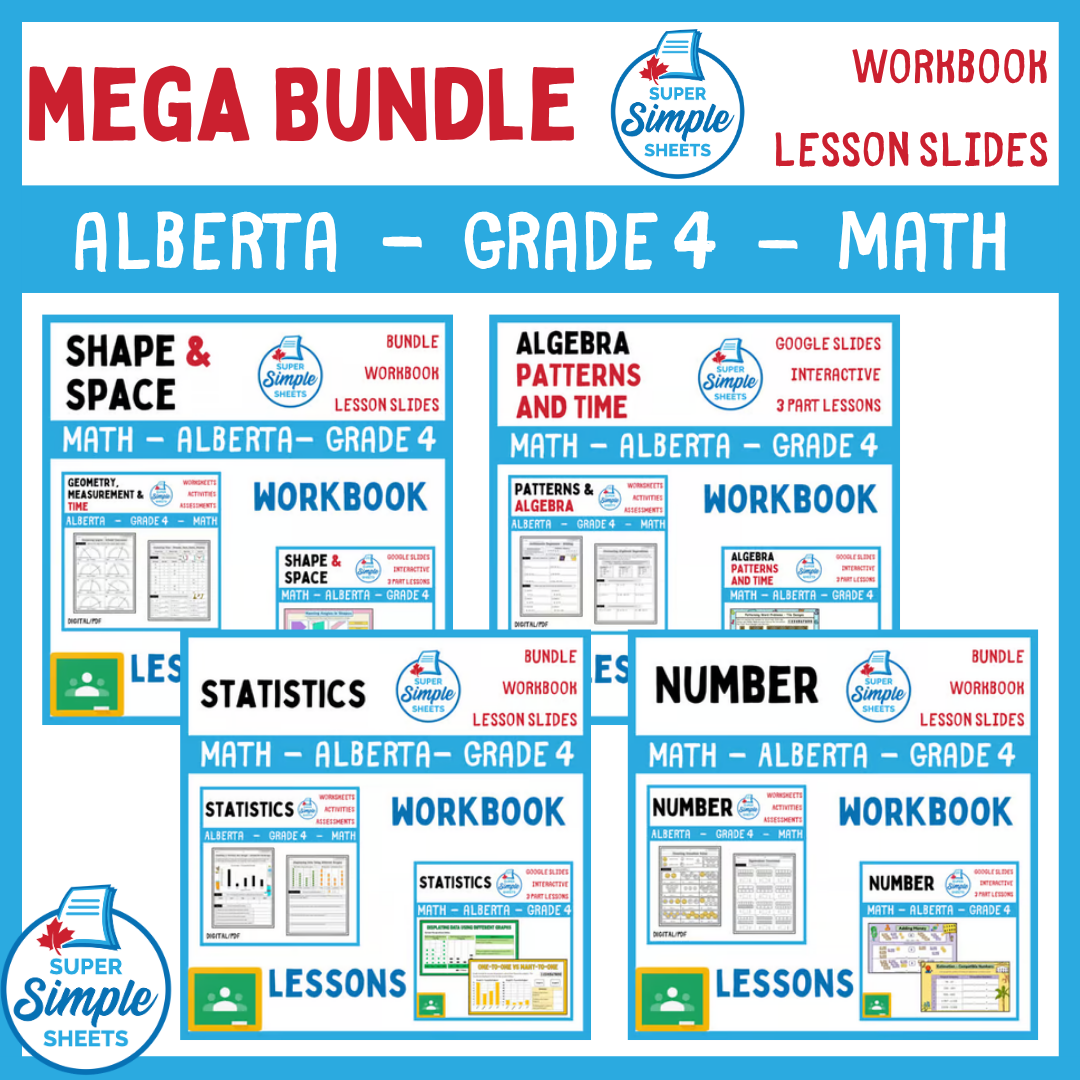
This mega bundle provides everything you need to teach all the units in the Grade 4 Alberta Math Curriculum.
With your purchase, you will receive lesson slides that follow the 3-Part lesson format, engaging your students from start to finish. You will also receive the workbooks, which contain fun activities and worksheets for your students to demonstrate their understanding.
Shape and Space Unit
Workbook
Some of the concepts that are covered:
- Regular vs Irregular Polygons
- Sides and Vertices
- Naming and Sorting Angles
- Angles in Triangles and Rectangles
- Naming Angles – Right, Obtuse, Acute, and Straight
- Acute, Obtuse, and Right Triangles
- Types of Triangles – Equilateral, Scalene, Isosceles
- Parallel, Perpendicular and Intersecting Lines
- Diagonals
- Quadrilaterals – Diagonals, Trapezoids, Kite, Parallelogram
- Perpendicular and Parallel Line Segments
- Complementary and Supplementary Angles
- Prisms – Faces, Edges, Vertices
- Lines in 3D Objects - Prisms
- Describing & Performing Translation
- Translating Shapes – Cartesian Plane
- Reflection or Not?
- Drawing Reflections
- Reflecting Shapes – Cartesian Plane
- Clockwise and Counterclockwise Rotations
- Rotating Shapes - Cartesian Plane
- Transformations of 3D Objects
- Measuring in Centimetres and Millimetres
- Non-Standard Units - Area
- Comparing Area - Ordering
- Calculating Area Using CM
- Finding the Area of Rectangles
- Referents For Square Centimeter
- Measuring Angles
- Naming Angles – Right, Obtuse, Acute, and Straight
- Constructing Angles - Estimating
- Constructing Triangles
- Relating Angles to Fractions of a Circle
- Telling Time – Digital Clocks
- Digital Clocks – How Much Time Has Elapsed
- Activity: Making a Clock
- Analog Clocks
- Elapsed Time – Nearest Hour
- Elapsed Time Using Fractions
- Measuring Time – Seconds, Days, Hours, Minutes, Days, Weeks, Months, Years
- Elapsed Time Using Timelines
- Hands-on Activities: Four Corners Activity: Identifying Quadrilaterals, Math Activity: Translation Relay Race, Activity: Reflecting Real-Life Shapes, Math Activity: Rectangle Rally, Math Activity: Time Travelers, Matching Game: Telling Time To The Nearest Minute, Task Cards: Elapsed Time
- Exit cards x 14
- 5 Unit Tests
- Answer pages for all activities
Number Unit
Workbook
Some of the concepts that are covered:
- Place value within 100 000
- Place value of decimal numbers, including tenths and hundredths
- Express numbers, including decimal numbers, using words and numerals
- Expanded form of natural numbers and decimal numbers
- Decimal notation in English and French
- Rounding numbers, including to the nearest tenth
- Compare and order numbers, including decimal numbers
- Compare cents (decimal numbers) to dollars (whole numbers)
- Add and subtract numbers within 10 000
- Add and subtract decimal numbers to hundredths
- Assess the reasonableness of a sum or difference using estimation
- Adding and subtracting money amounts (decimal numbers)
- Determining factors of a number within 100
- Describe a number as prime or composite
- Determine the first five multiples of a given number within 100
- Recognize the greatest common factor of two numbers within 100
- Multiplication and division facts using numbers to 12
- Patterns in multiplying and dividing by 10, 100, 1000
- Multiply and divide 3-digit natural numbers by 1-digit natural numbers using standard algorithms
- Divide and express a quotient with or without a remainder
- Investigate strategies for estimation of products and quotients
- Assess the reasonableness of a product or quotient using estimation
- Model equivalent fractions by partitioning a whole
- Compare and order fractions
- Simplify fractions
- Relate fractions to decimals
- Compare percentages within 100
- Express relationship between fractions, decimals, and percent
- 15 Exit Cards
- Hands-On Activities: Task Cards: Place Value, Decimal Bottle Flip Challenge, Decimal Treasure Hunt, The Multiplication Magic Show, Multiplication Race, Division Race, Memory Game: Matching Equivalent Fractions, Fraction/Decimal Bottle Flip Challenge, Math Basketball: Missing Percentages Challenge.
- 4 Unit tests
- Answer pages for all activities
Algebra - Patterns and Time Unit
Workbook
Some of the concepts that are covered:
- Fibonacci sequence (patterns)
- Increasing and decreasing sequences (patterns)
- Creating increasing and decreasing sequences
- Representing a concrete or pictorial sequence using numbers
- Table of values
- Arithmetic sequences – addition and subtraction
- Geometric sequences – multiplication
- Describing a sequence using a pattern rule
- Initial value of a pattern and constant change
- Determining the missing value in different sequences using all operations
- What are equations?
- What are expressions? Differences between equations and expressions
- Evaluating expressions
- Creating multiple expressions that represent the same number
- Writing equations that represent a situation
- Writing expressions that represent a situation
- Preservation of equality
- Finding the unknown number in an equation
- Solving word problems using equations to represent the problem
- 9 Exit Cards
- Hands-On Activities: Activity : Exploring Arithmetic Sequences, Task Cards: Patterning – All Operations, Mystery Number Challenge, Algebraic Bottle Flip Challenge, Activity – Equation Explorers, Algebra Jeopardy
- 2 Unit Tests
- Answer pages for all activities
Statistics Unit
Workbook
Some of the concepts that are covered:
- What is a statistical question?
- Creating statistical questions to investigate
- The statistical problem-solving process
- What the scale of a graph is
- How to determine an appropriate scale
- Reading different graphs with the same data but different scales
- The effects scale has on graphs
- When to use each type of graph – dot plot, bar graph, pictograph
- The same data represented in each of the different graphs – dot plot, bar graph, pictograph
- Interpret data in different types of graphs
- Complete the statistical problem-solving process
- Create a statistical question, collect data, represent the data using an appropriate graph, and interpret the data
- Answer pages for all activities
- Hands-on Activities: Research Activity: Graph Hunter, Flip the Data.
- Exit Cards x 5
- 1 Unit Test
Google Lesson Slides
Grade 4 - Google Lesson Slides - Alberta Math Curriculum. This resource is packed with all the lessons you need to teach the Grade 4, Alberta Math Curriculum.
We have structured these lessons to follow the popular 3-Part Lesson format. By using these lessons, you will be provided with learning goals, discussion questions, relevant YouTube videos, interactive slides, exit cards, and more. Check out the variety of activities you'll receive below.
Part 1: Minds On!
- Learning Goals
- Discussion Questions
- Polls/Surveys
- Picture Prompts
- Jokes and Riddles
- Relevant Quotes
Part 2: Action!
- Interactive Activities
- Drag and Drop
- Fill in the Blanks
- Matching
- Sorting
- Polls/Surveys and Graphing
- Embedded YouTube Videos
Part 3: Consolidation
- Exit Cards
- 3-2-1 Reflections
- One Word Reflections
- Act It Out!
- Quick Draw
- One Sentence Summary
After purchasing this resource, you will be able to download copies of the Google Slides for the three different units to your Google Drive. From there, you can complete these lessons with your class, and/or assign these slides in Google Classroom.