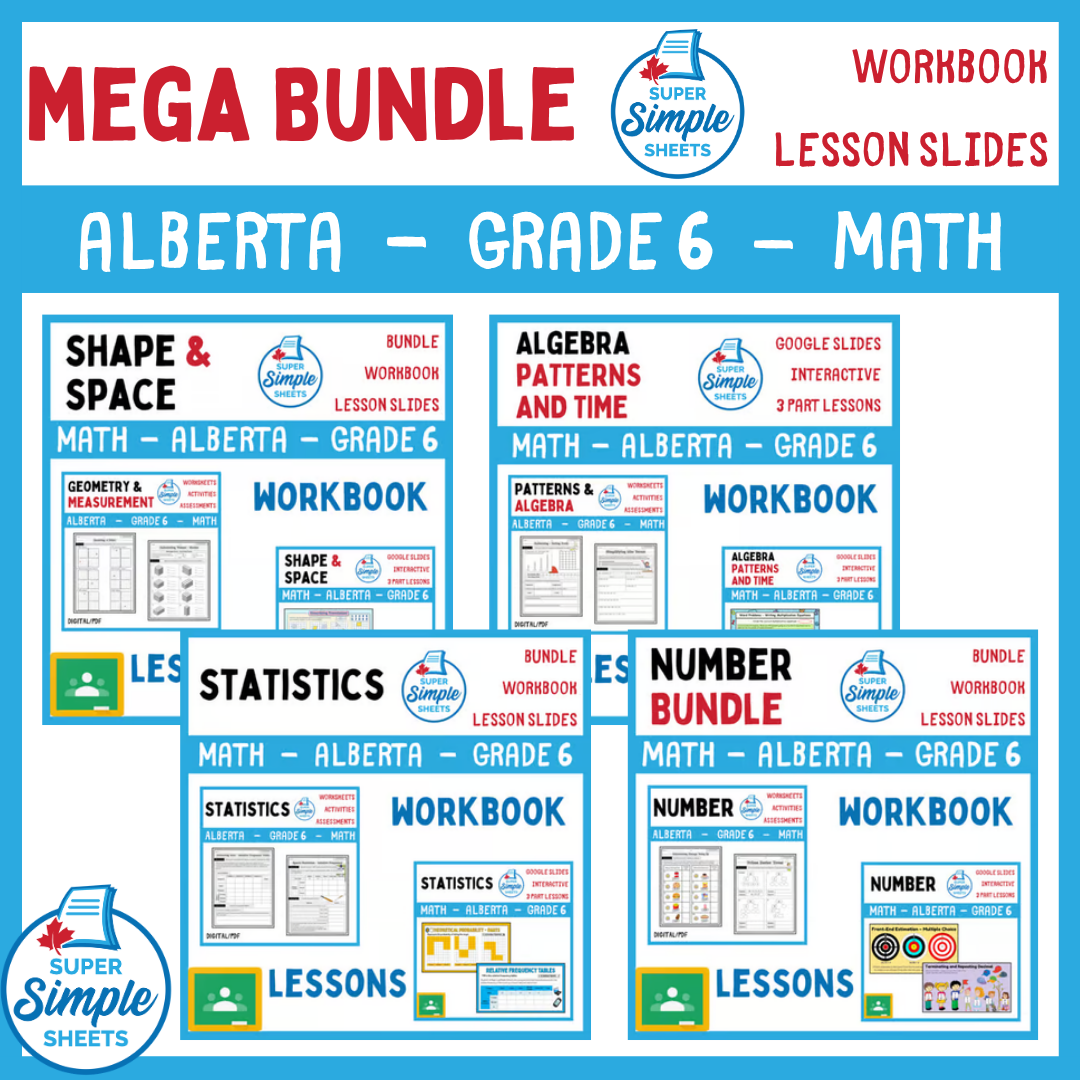

Grade 6 - Alberta Math - Lessons/Workbook Mega Bundle
Grade 6 - Alberta Math - Lessons/Workbook Mega Bundle
Interested in a bundle? Shop below instead!
Couldn't load pickup availability
This mega bundle provides everything you need to teach all the units in the Grade 6 Alberta Math Curriculum.
With your purchase, you will receive lesson slides that follow the 3-Part lesson format, engaging your students from start to finish. You will also receive the workbooks, which contain fun activities and worksheets for your students to demonstrate their understanding.
Shape and Space Unit
Workbook
Some of the concepts that are covered:
- Congruency of polygons – measuring angles and side lengths
- Symmetry of shapes
- Transformations used to create designs
- Tessellations
- Symmetry in tessellations
- Tessellations in Indigenous designs
- Locate and plot points on a cartesian plane
- Four-quadrant cartesian plane
- Plotting a polygon on a cartesian plane using its vertices
- Describing the positioning of a polygon on a cartesian plane
- Translate, reflect, and rotate polygons on a cartesian plane
- Reflect a polygon over the x-axis and y-axis
- Describe the line of reflection
- Rotate a polygon 90°, 180°, or 270° clockwise and counter-clockwise
- Describe a rotation using angle and direction
- Describe the coordinates of a point after a translation, rotation, or reflection
- Find the area of a triangle and parallelogram
- Relate the area of a parallelogram to two triangles
- Relate the area of a parallelogram to one rectangle
- Relate the area of a triangle to a rectangle
- Find the unknown length when given the area of a parallelogram or triangle
- Solve word problems involving area
- Finding the area of composite shapes – combination of rectangles, parallelograms, and triangles
- Volume and capacity
- Calculate the volume of a right rectangular prism
- Volume word problems
- Hands-on Activities: Matching Activity: Congruent Shapes, Translation Relay Race, Rotation Art Spinner, Cartesian Coordinate Toss Challenge, Around the World Math Race: Converting L and ML, Task Cards: Area Calculation Expedition, Volume Jeopardy.
- Exit Cards x 9
- Answer pages for all activities
- 4 Unit Tests
Number Unit
Workbook
Some of the concepts that are covered:
- Negative numbers in familiar contexts
- Negative integers – zero pairs
- Magnitude is the distance from zero on the number line
- Compare and order positive and negative integers
- Add positive and negative integers
- Find the difference between positive and negative integers
- Solve addition and subtraction questions
- Add and subtract decimal numbers, including questions related to money
- Compose a product in multiple ways – commutative property
- Factor trees – prime factorizations
- Determine factors for natural numbers
- Powers and exponents
- Represent the factors of a natural number using powers
- Use standard algorithms to multiply and divide decimal and natural numbers
- Multiply and divide up to 3-digit by 2-digit numbers
- Estimate products and quotients to help determine the reasonableness of an answer
- Model equal-sharing situations using fractions
- Express a fraction as a division statement
- Mixed numbers and improper fractions
- Add and subtract fractions with common denominators
- Add and subtract fractions with unlike denominators
- Add and subtract mixed numbers
- Multiply a natural number by a fraction
- Equivalent rates and ratios
- Relate percentage to ratios
- Hands-on Activities: Math Jeopardy – Adding Integers, Activity: Four Corners Money Addition, Activity: Multiplication Race, Math Jeopardy – Multiplication 2 x 2 Digits, Four Finger Quiz - Decimal Multiplication, Quiz Creator Competition: Decimal Division Challenge, Memory Game: Matching Equivalent Ratios
- Exit cards x 17
- 4 Unit tests
- Answer pages for all activities
Algebra - Patterns and Time Unit
Workbook
Some of the concepts that are covered:
- Input/output tables – introduction to functions
- Identifying the independent and dependent variable in patterns
- Describing pattern rules
- Graphing patterns using a cartesian plane
- Representing patterns in a table of values
- Determine the function of a pattern in a table of values
- Write an algebraic expression that represents a function
- Recursive vs functional relationships
- Linear functions – patterns that have a straight line
- Understand that the independent variable is plotted on the x-axis
- Determine the unknown value of the dependent variable of a function
- Determine the unknown value of the independent variable of a function
- Solve word problems involving functions
- Evaluate expressions involving parentheses and powers
- Understanding terms in an algebraic expression
- Simplify like terms
- Simplify algebraic expressions using their algebraic properties
- Communitive property – addition and multiplication
- Associative property – addition and multiplication
- Solving equations limited to two operations
- Represent situations using equations
- BEDMAS – equations and expressions
- Hands-On Activities: Task Cards: Patterning – All Operations, Finger Signals Quiz - Understanding Algebraic Expressions, Math Hot Seat: Addition Challenge, Math Basketball: Addition Equations Challenge, Algebraic Bottle Flip Challenge, Math Tic-Tac-Toe: Solving Variables, Multiplication Race, Matching Game: Do The Variables Match, Algebra Jeopardy.
- 2 Unit Tests
- 12 Exit Cards
- Answer pages for all activities
Statistics Unit
Workbook
Some of the concepts that are covered:
- Frequency tables
- Relative frequency
- Expressing relative frequencies as fractions, decimals, and percentages
- Interpret data and categorize it in a relative frequency table
- Interpret a relative frequency table and draw conclusions from it
- Statistical questions
- Creating statistical questions of interest
- Collecting data and categorizing it into a relative frequency table
- Determining the possible outcomes of an event
- Identifying if an event is likely, unlikely, equally likely, impossible or certain
- Theoretical and experimental probability
- Describe the likelihood of an outcome in an experiment using relative frequency
- Analyze data from an experiment and represent it using relative frequency
- Perform an experiment and represent the results using relative frequency
- Analyze relative frequency statistics from experiments with different sample sizes
- Experiments include: rolling a dice and flipping a coin
- Unit test
- Answer pages for all activities
- Hands-on Activities: Probability Card Sort and Rank, Probability Bottle Flip Challenge
- Exit Cards x 5
- 1 Unit Test
Google Lesson Slides
Grade 6 - Google Lesson Slides - Alberta Math Curriculum. This resource is packed with all the lessons you need to teach the Grade 6, Alberta Math Curriculum.
We have structured these lessons to follow the popular 3-Part Lesson format. By using these lessons, you will be provided with learning goals, discussion questions, relevant YouTube videos, interactive slides, exit cards, and more. Check out the variety of activities you'll receive below.
Part 1: Minds On!
- Learning Goals
- Discussion Questions
- Polls/Surveys
- Picture Prompts
- Jokes and Riddles
- Relevant Quotes
Part 2: Action!
- Interactive Activities
- Drag and Drop
- Fill in the Blanks
- Matching
- Sorting
- Polls/Surveys and Graphing
- Embedded YouTube Videos
Part 3: Consolidation
- Exit Cards
- 3-2-1 Reflections
- One Word Reflections
- Act It Out!
- Quick Draw
- One Sentence Summary
After purchasing this resource, you will be able to download copies of the Google Slides for the three different units to your Google Drive. From there, you can complete these lessons with your class, and/or assign these slides in Google Classroom.