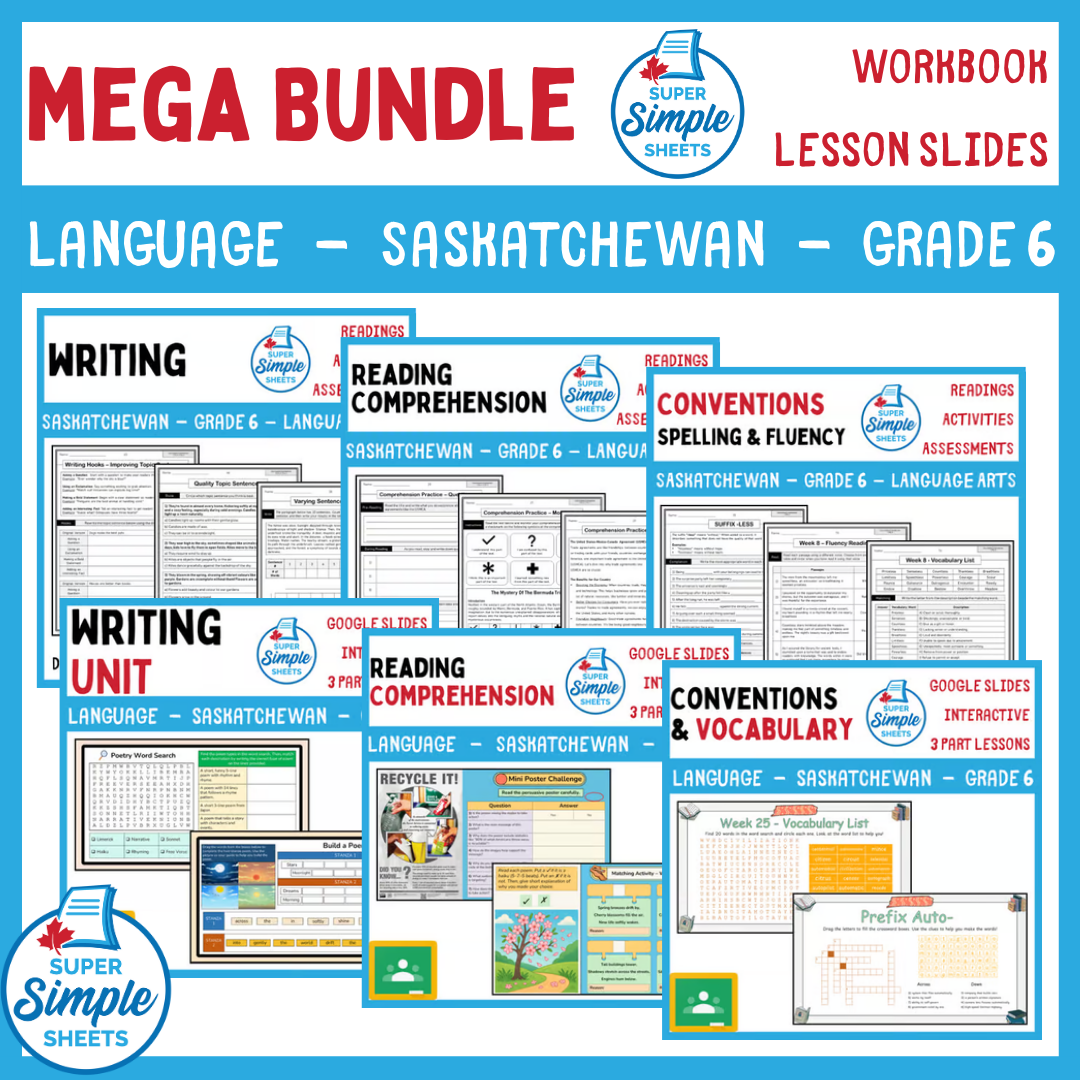

Grade 6 - Saskatchewan Language - Lessons/Workbook Mega Bundle
Grade 6 - Saskatchewan Language - Lessons/Workbook Mega Bundle
Interested in a bundle? Shop below instead!
Couldn't load pickup availability
This mega bundle provides everything you need to teach all the units in the Grade 6 Saskatchewan Language Curriculum.
With your purchase, you will receive lesson slides that follow the 3-Part lesson format, engaging your students from start to finish. You will also receive the workbooks, which contain fun activities and worksheets for your students to demonstrate their understanding.
Writing Unit
Workbook
Some of the concepts that are covered:
- Types of text forms – when to use each one (narratives, letters/emails, persuasive, comic strips, reports, etc.)
- Experiment – writing with planning time versus writing without planning time (no brainstorming)
- Activity – voice in song lyrics
- Word choice – choosing appropriate words for our audience
- Analyzing word choices by professional authors
- Personal voice in writing
- Fluent writing – using punctuation, transition words, and logical sequencing of ideas
- How to write a perfect paragraph – topic sentence (hook), body (supporting details), conclusion
- Formal versus informal letter writing – voice in our writing
- Purpose and audience in letter writing – effect on our voice
- Narrative writing – beginning, middle, end
- Narrative structure – exposition, rising action, climax, falling action, resolution
- Writing using figurative language – similes, metaphors, imagery
- Characterization – creating funny, mysterious, fantasy, and adventurous characters
- Character development – describe how characters change over time due to big events
- Using quotations in our narratives – dialogue
- Adding quotations to pre-made stories
- Activity – Being Persuasive: Debate
- Understanding bias in persuasive writing
- Assignment – advertising a new invention
- Confirmation bias in persuasive writing
- Expository text forms – reports, lists, problem/solution report, compare/contrast essay, cause and effect essay
- Multimedia how-to-guide: taking pictures to represent and support text in a how-to-guide
- Writing a report – Canada’s Trading Partners and All About Elephants
- Research process – questioning, gathering, organizing, and recording
- How to research effectively – trustworthy sources, using keywords
- Ethical research – citing sources, fair representation of information, and asking permission
- Writing a problem/solution report
- Types of poems – Haiku, Limerick, Rhyming Poems, Acrostic Poems
- Assignment – writing a poetry children’s book
- Activity – rhyme time analysis
- Cursive writing – Limerick
- Comic strips – onomatopoeia and illustrating graphic texts
- Assignment - creating an online comic strip
- Genres in different text forms – adventure, humour and other genres in graphic text
- Biographies – cross curricular connections: Ben Franklin and Nikola Tesla (electricity), Sally Ride (space)
- How to cite where we find research – bibliography
- Activity – Partner Biography/Bibliography Assignment
- Reconstructing texts – translating texts from one form to another – e.g., letter to news report, infographic to story
- Inquiry project – students choose a topic and formulate questions to guide their research
- Answer pages for all activities
Reading Comprehension Unit
Workbook
Some of the concepts that are covered:
- What is reading comprehension?
- Before reading: comprehension strategies – activating prior knowledge and reasons for reading
- During reading: comprehension strategies – questioning, making connections, inferences, predictions, visualizing
- After reading: comprehension strategies – summarizing, making global and local inferences, visualizing
- Activity: Exploring Ecosystems – using before reading, during reading, and after reading strategies
- Reading stamina progress charts
- Identity, social responsibility and efficacy
- Monitoring understanding of texts – use strategies to refocus and re-engage when reading complex texts
- Cultural text forms – creation stories and songs
- Letter writing – emails, formal and informal letters, bias
- Implicit and explicit perspectives in letter writing
- Voice in writing – use of cohesive ties and different sentence structures
- Activity - determining the voice used in popular songs
- Narratives – use of literary devices: hyperbole, idiom, alliteration, metaphor, imagery, simile
- Narrative structure – exposition, rising action, climax, falling action, resolution
- Comedy story, tragedy story, and historical fiction story
- Character analysis – protagonist, antagonist and stock characters
- Characterization – character traits, decision making, and evolution of characters
- Describing the identity of fictional characters and comparing that identity with their own
- Perspective in narratives – first-person, second-person, and third-person and advantages/disadvantages of each
- Narratives – sequencing multiple plots in a story and explaining cause and effect
- Indigenous Storywork – 7 Principles: respect, responsibility, reciprocity, reverence, holism, interrelatedness, synergy
- Cross-curricular connections – text forms related to themes in science and social studies (electricity, USMCA)
- Persuasive writing – using critical thinking skills to determine bias
- Techniques of persuasion: the use of emotional and logical appeals to persuade
- Perspectives in writing – how our perspectives change/evolve (passage of time, new information, experience, etc.)
- Finding implicit and explicit evidence in persuasive texts
- Text features in reports – headings, subheadings, pull-down menus, hyperlinks, captions, tables, graphs, etc.
- Reports on diversity, inclusion, accessibility, social issues, moral dilemmas, and social justice
- Research – Confirm the accuracy of information presented in a report
- Land Literacy Report: Inuit inuksuit, Métis lobsticks, Coastal First Nations totem poles
- Expository texts – How to guides
- Use of graphs, maps, diagrams, and pictures in reports
- Literary devices used in poetry – idioms and hyperbole
- Assignment – dissecting poems written by Indigenous authors
- Understanding haiku, limericks, acrostic poems, cinquain poems, and rhyming poems
- Activity: detecting bias in online reviews
- Reading different styles (voices) in book reviews
- Text features in biographies – using a glossary and a preface to understand a biography
- Chris Hadfield, Elijah Harper, and David Suzuki biographies with prefaces and glossaries
- Activity: analyzing multimedia features (bold fonts, visuals, layout, music, colours, etc.)
- Metacognitive strategies: reading tracking charts and reading goals
- Answer pages for all activities
Language Conventions and Vocabulary Unit
Workbook
Some of the concepts that are covered:
- Suffixes: -en, -ize, -ing, -ly, -able, -less, -ment, -ful, -ness, -tion, -ous, -y, -ize, -ship and many more
- Prefixes: pro-, com-, con-, en-, oc-, re-, dis-, pre-, ex-, in-, non-, sub-, inter-, anti-, mis-, super-, and many more
- Reading strategies – questioning, predicting, summarizing, making inferences, and visualizing activities
- Complete sentences versus fragments
- Simple and compound sentences
- Using independent and dependent clauses in sentences
- Parts of speech – nouns, verbs, adjectives, adverbs, pronouns, prepositions, conjunctions, interjections
- Run-on sentences
- Four types of sentences – declarative, interrogative, exclamatory, imperative
- Conjunctions – FANBOYS
- Building complex sentences and subordinating conjunctions
- Compound-complex sentences
- Literary devices – similes, metaphors, personification, symbolism, and imagery
- Creating complex sentences with adjective clauses/relative clauses
- Nouns that are gerunds
- Distinguishing and converting between active and passive voice
- Palindromes
- Commas with clauses and commas in a list
- Colons for introducing a list, colons in formal letters, colons in memo salutations
- Colons to give an explanation or an example
- Semicolons versus commas
- Commas with direct address, commas with appositives, commas after transitional words
- Vocabulary – using context clues to read unfamiliar words
- Subject-verb agreement
- Identifying synonyms
- Using expression and intonations while reading
- Capitals for historical periods or events
- Proper adjectives and capitalization
- Regional dialects – standard Canadian English versus American English, formal/informal registers, slang
- Formal and informal language – slang, social media texts, academic language
- Reconstructing texts – changing a news article into a short story or a formal text message into an informal one
- Word origins – words influenced by people, places, and events in history
- Fluency readings for each week to reinforce word list vocabulary
- Weekly quizzes (30 different assessments)
- Answer pages for all activities
Google Lesson Slides
Grade 6 - Google Lesson Slides - Saskatchewan Language Curriculum. This resource is packed with all the lessons you need to teach the Grade 6, Saskatchewan Language Curriculum.
We have structured these lessons to follow the popular 3-Part Lesson format. By using these lessons, you will be provided with learning goals, discussion questions, relevant YouTube videos, interactive slides, exit cards, and more. Check out the variety of activities you'll receive below.
Part 1: Minds On!
- Learning Goals
- Discussion Questions
- Polls/Surveys
- Picture Prompts
- Jokes and Riddles
- Relevant Quotes
Part 2: Action!
- Interactive Activities
- Drag and Drop
- Fill in the Blanks
- Matching
- Sorting
- Polls/Surveys and Graphing
- Embedded YouTube Videos
Part 3: Consolidation
- Exit Cards
- 3-2-1 Reflections
- One Word Reflections
- Act It Out!
- Quick Draw
- One Sentence Summary
After purchasing this resource, you will be able to download copies of the Google Slides for the three different units to your Google Drive. From there, you can complete these lessons with your class, and/or assign these slides in Google Classroom.