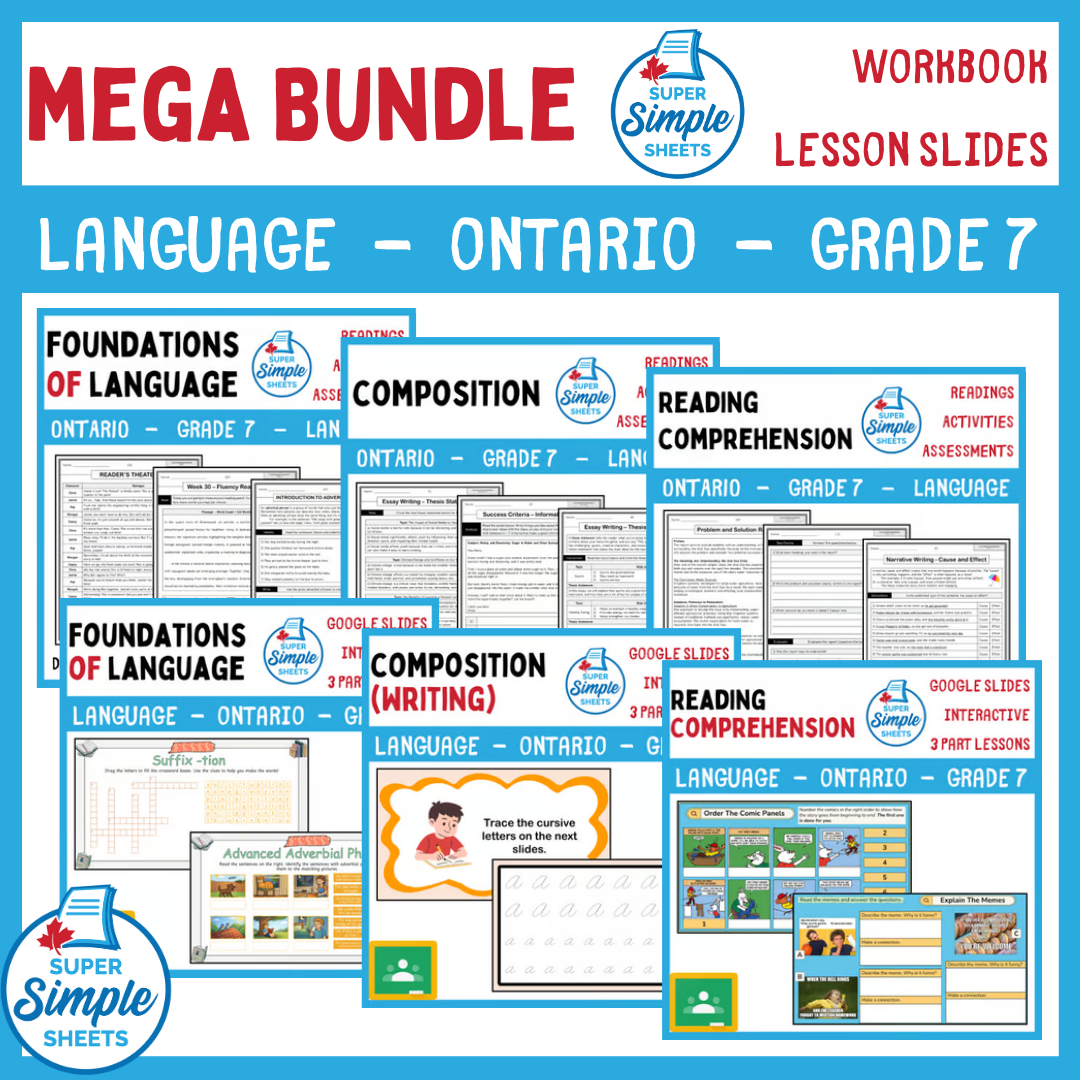

Grade 7 - Ontario Language - Lessons/Workbook Mega Bundle
Grade 7 - Ontario Language - Lessons/Workbook Mega Bundle
Interested in a bundle? Shop below instead!
Couldn't load pickup availability
This mega bundle provides everything you need to teach all the units in the Grade 7 Ontario Language Curriculum.
With your purchase, you will receive lesson slides that follow the 3-Part lesson format, engaging your students from start to finish. You will also receive the workbooks, which contain fun activities and worksheets for your students to demonstrate their understanding.
Foundations of Language Unit
Workbook
Some of the concepts that are covered:
- Suffixes: -ing, -ly, -able, -less, -ment, -ful, -ness, -tion, -ous, -y, -ize, -ship and many more
- Prefixes: un-, re-, dis-, pre-, ex-, in-, non-, sub-, inter-, anti-, mis-, super-, and many more
- Recognizing and fixing run-on sentences
- Using coordinating conjunctions in compound sentences
- Building complex sentences with subordinating conjunctions
- Understanding and applying correlative conjunctions
- Differentiating between simple, compound, and complex sentence structures
- Creating compound-complex sentences
- Comprehending and using imperative sentences, declarative, interrogative, exclamatory sentences
- Introducing predicate nouns and predicate adjectives
- Exploring participles and participial phrases
- Enhancing writing with adverbial phrases
- Correctly placing commas after transitional words
- Utilizing commas for introductory phrases
- Expanding vocabulary using context clues
- Mastering frequently misspelled words
- Adjusting expression for different genres
- Performing with Reader’s Theatre: tone and pacing
- Strengthening fluency with increasingly challenging readings
- Learning the basics of capitalization and its advanced rules
- Applying punctuation: periods, question marks, colons for quotations
- Understanding semicolons and their advanced usage
- Enhancing writing with conjunctive adverbs
- Utilizing ellipses and dashes for effect
- Expanding vocabulary with thesaurus and morphology skills
- Oral communication – Listening Relay, Two Types of Listening, Questioning Quest
- Activities – Constructive Feedback, The Question-Asking Game, The Paraphrase Chain
- Activities – Podcast Detective, Speech Swap, Speech Makeover
- Activities – Formal vs. Informal Chats, Non-Verbal Communication, Cultural Charades, and more
- Weekly quizzes (30 different assessments)
- Answer pages for all activities
Composition (Writing) Unit
Workbook
Some of the concepts that are covered:
- Types of text forms – when to use each one (narratives, letters/emails, persuasive, comic strips, reports, etc.)
- Experiment – writing with planning time versus writing without planning time (no brainstorming)
- Activity – Secret Agent Notes
- Personal voice in writing
- How to write a perfect paragraph – topic sentence (hook), body (supporting details), conclusion
- Essay writing – how to write a thesis statement
- Writing a 5-paragraph essay
- Formal versus informal letter writing – voice in our writing
- Narrative writing – beginning, middle, end
- Analyzing quality stories – building success criteria
- Using quotations in narrative writing – dialogue
- Activity – Story Swap Revision
- Understanding persuasive writing
- Activity – Being Persuasive: Debate
- Understanding bias in persuasive writing
- Assignment – advertising a new invention
- Expository text forms – reports, lists, problem/solution report, compare/contrast essay, cause and effect essay
- Writing a How-To-Guide
- Synthesizing multiple reports
- Writing a report – different types of bears and the importance of bees
- How to research effectively – trustworthy sources, using keywords
- Activity – Online Treasure Hunt
- Writing a problem/solution report
- Determining solutions to problems
- Types of poems – Haiku, Limerick, Rhyming Poems, Acrostic Poems
- Assignment – writing a poetry children’s book
- Cursive writing – Limerick
- Comic strips – onomatopoeia and illustrating graphic texts
- Assignment - creating an online comic strip
- Biographies – cross curricular connections: Louis Riel, Leif Erikson, and Laura Secord
- How to cite where we find research – bibliography
- Activity – Partner Biography/Bibliography Assignment
- Cursive writing package/booklet
- Answer pages for all activities
Reading Comprehension Unit
Workbook
Some of the concepts that are covered:
- What is reading comprehension?
- Before reading: comprehension strategies – activating prior knowledge and reasons for reading
- During reading: comprehension strategies – questioning, making connections, inferences, predictions, visualizing
- After reading: comprehension strategies – summarizing, inferences, synthesizing, evaluating, visualizing
- Cultural text forms – creation stories and songs
- Indigenous Storywork – 7 Principles: respect, responsibility, reciprocity, reverence, holism, interrelatedness, synergy
- Indigenous storytelling – values, rituals, ceremonies, architecture, art, and dance
- Cross-curricular connections – text forms related to themes in science and social studies (deforestation, structures)
- Adjusting reading rates: Learning to read at different speeds based on the text's difficulty.
- Vocabulary in context: Learning new words through their use in texts.
- Voice in letter writing
- Bias in letter writing, book reviews, and in persuasive writing
- Making inferences from letter writing
- Narratives – finding examples of literary devices: allegory, symbolism, and foreshadowing
- Sequencing a narrative – rearranging a plot
- Determining the causes and effects in narratives
- Implicit versus explicit evidence in persuasive texts
- Expository texts – informational reports
- Text patterns in cause-and-effect essays, problem-and-solution reports, five-paragraph essays, compare and contrast essays
- Identifying thesis statements found in reports and essays
- Synthesizing information in reports and essays
- Blog post – text patterns
- Identifying literary devices in poetry – allegory, foreshadowing, and symbolism
- Analyzing poems – haiku, limerick, acrostic, cinquain, and rhyming poetry
- Studying poetry written by Indigenous authors
- Explicit and implicit perspectives in book reviews
- Activity – detecting bias in online reviews
- Graphic texts – timelines, memes, comics, infographics, maps
- Biographies – Viola Desmond, Tecumseh, Bertha Clark Jones, Alexander Graham Bell, and Warren Buffet
- Answer pages for all activities
Google Lesson Slides
Grade 7 - Google Lesson Slides - Ontario Language Curriculum. This resource is packed with all the lessons you need to teach the Grade 7, Ontario Language Curriculum.
We have structured these lessons to follow the popular 3-Part Lesson format. By using these lessons, you will be provided with learning goals, discussion questions, relevant YouTube videos, interactive slides, exit cards, and more. Check out the variety of activities you'll receive below.
Part 1: Minds On!
- Learning Goals
- Discussion Questions
- Polls/Surveys
- Picture Prompts
- Jokes and Riddles
- Relevant Quotes
Part 2: Action!
- Interactive Activities
- Drag and Drop
- Fill in the Blanks
- Matching
- Sorting
- Polls/Surveys and Graphing
- Embedded YouTube Videos
Part 3: Consolidation
- Exit Cards
- 3-2-1 Reflections
- One Word Reflections
- Act It Out!
- Quick Draw
- One Sentence Summary
After purchasing this resource, you will be able to download copies of the Google Slides for the three different units to your Google Drive. From there, you can complete these lessons with your class, and/or assign these slides in Google Classroom.