

Grade 7 - Reading Comprehension - Saskatchewan Language - Lesson/Workbook Bundle
Grade 7 - Reading Comprehension - Saskatchewan Language - Lesson/Workbook Bundle
Interested in a bundle? Shop below instead!
Couldn't load pickup availability
Grade 7 - Reading Comprehension Unit - Saskatchewan Language Curriculum - Lesson/Workbook Bundle. This bundle was created to provide everything you need to teach the Grade 7 Reading Comprehension unit in the Saskatchewan Language Curriculum.
With your purchase, you will receive lesson slides that follow the 3-Part lesson format, engaging your students from start to finish. You will also receive the workbook, which contains fun activities and worksheets for your students to demonstrate their understanding.
Workbook Details:
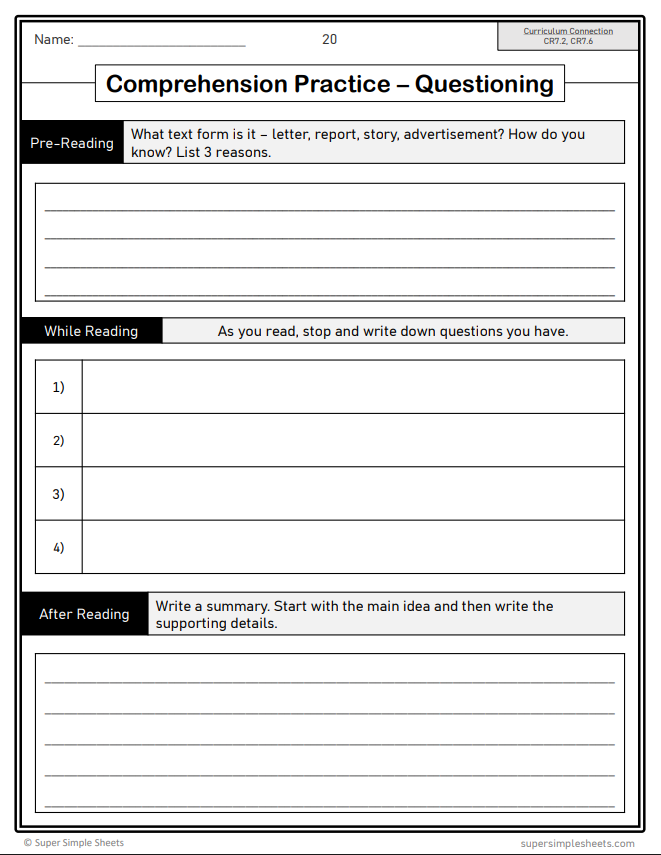
This 375-page resource covers all outcomes and indicators related to reading comprehension in the Saskatchewan Language Curriculum (ELA).
We’ve included a variety of activities, including independent reading responses, group activities, assignments, exemplars, and hands-on activities to keep your students engaged.
Included in this resource are the elaborations within the elements below:
Comprehend and Respond (CR) – read fluently and demonstrate comprehension of grade-appropriate texts.
Assess and Reflect (AR) – reflect and set personalized goals related to reading fluency and comprehension.
In addition, we have included a full-year long range plan that outlines what concepts from the curriculum you will be teaching each week/block.
Some of the concepts covered:
- What is reading comprehension?
- Reading stamina progress charts
- Comprehension Practice – Refocusing / Re-engaging
- Letter writing – emails, formal and informal letters, bias
- Implicit and explicit perspectives in letter writing
- Voice in writing – use of cohesive ties and different sentence structures
- Narratives – use of figurative language: personification, similes, metaphors, anthropomorphism, humour, and imagery
- Perspective in narratives – first-person, second-person, and third-person and advantages/disadvantages of each
- Narratives – sequencing multiple plots in a story and explaining cause and effect
- Science fiction story - the use of flash-forwards in narratives
- Story genres – fantasy, humour, and adventure
- Narrative structure – exposition, rising action, climax, falling action, resolution
- Indigenous Storywork – 7 Principles: respect, responsibility, reciprocity, reverence, holism, interrelatedness, synergy
- Prediction story activity – finishing a story using strong predictions
- Cross-curricular connections – text forms related to themes in science and social studies (government, human body)
- Character analysis – explain the decisions made by characters and analyze their character traits
- Character identity – comparing the identities of characters to their own identity
- Story – Character Identification And Comparison
- Round vs. flat characters - explore differences in character types
- Persuasive writing – using critical thinking skills to determine bias
- Finding implicit and explicit evidence in persuasive texts
- Text features in reports – headings, subheadings, bold words, hyperlinks, captions, tables, graphs, etc.
- Using circle graphs in report writing
- Photo essay - analyze a photo essay
- Summarizing reports – determining the main idea and supporting details
- Activity – group work summarizing
- Expository texts – how to guides
- Use of graphs, maps, diagrams, and pictures in reports
- Propaganda – Critical Analysis
- Report – Justice, Equity And Fairness
- Literary devices used in poetry – humour and imagery
- Assignment – finding poems written by Indigenous authors
- Understanding haiku, limericks, acrostic poems, cinquain poems, and rhyming poems
- Bias in book reviews
- Reading different styles (voices) in book reviews
- Text features in comics, infographics, memes, and maps
- How images, graphics, and visuals contribute to biographies
- Text features in biographies – using a glossary and a preface to understand a biography
- Louis Riel, Terry Fox, and Albert Einstein biographies with prefaces and glossaries
- Activity: analyzing multimedia features (bold fonts, visuals, layout, music, colours, etc.)
- Metacognitive strategies: reading tracking charts and reading goals
- Answer pages for all activities
Google Lesson Slides
Grade 7 - Reading Comprehension Unit - Google Lesson Slides - Saskatchewan Language Curriculum. This resource is packed with all the lessons you need to teach the Reading Comprehension, Grade 7, Saskatchewan Language Curriculum.
We have structured these lessons to follow the popular 3-Part Lesson format. By using these lessons, you will be provided with learning goals, discussion questions, relevant YouTube videos, interactive slides, exit cards, and more. Check out the variety of activities you'll receive below.
Part 1: Minds On!
- Learning Goals
- Discussion Questions
- Quotes
Part 2: Action!
- Interactive Activities
- Drag and Drop
- Fill in the Blanks
- Matching
- Drawing
- Writing
Part 3: Consolidation
- Exit Cards
- Quizzes
- Reflection
After purchasing this resource, you will be able to download a copy of this file to your Google Drive. From there, you can complete these lessons with your class, and/or assign these slides in Google Classroom.