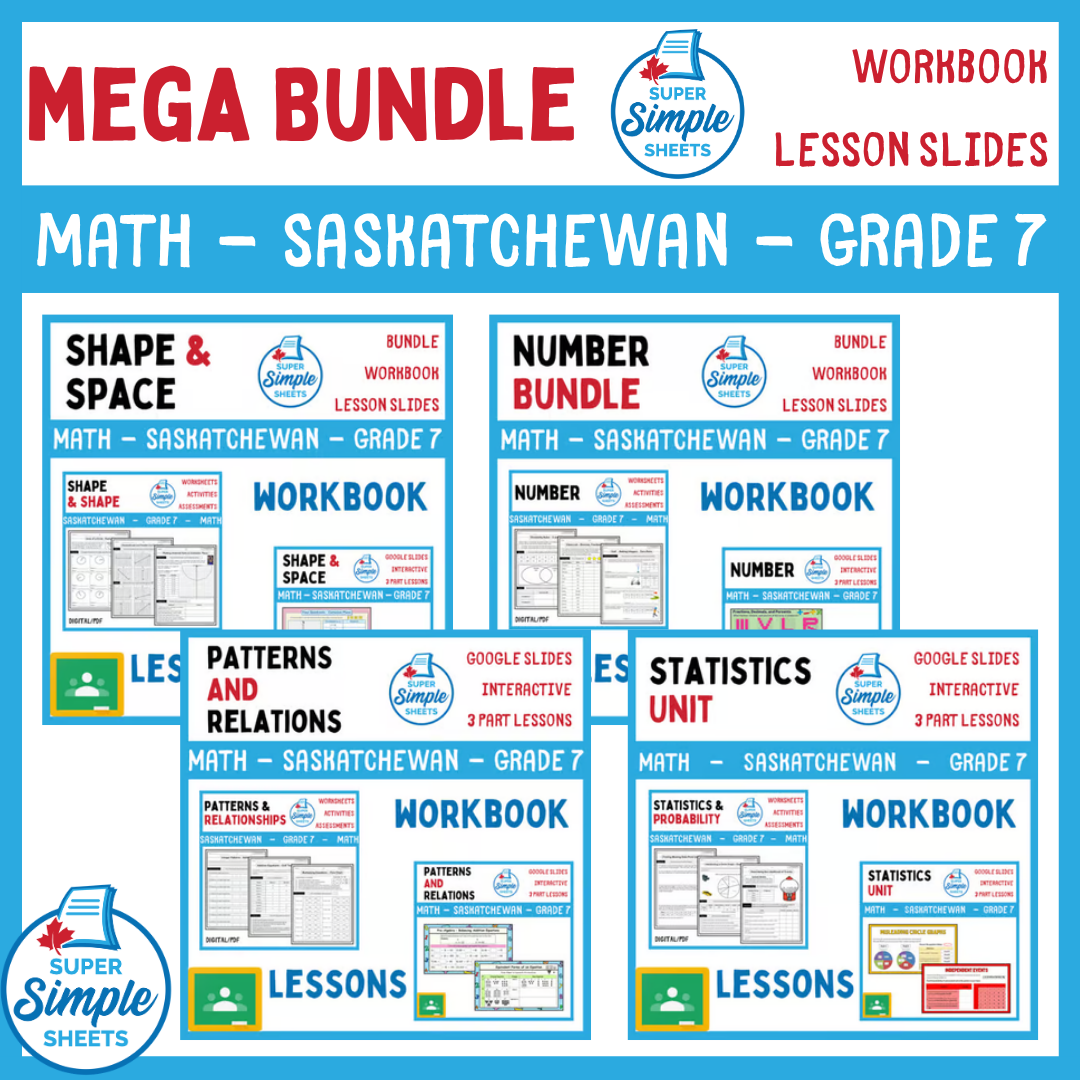

Grade 7 - Saskatchewan Math - Lessons/Workbook Mega Bundle
Grade 7 - Saskatchewan Math - Lessons/Workbook Mega Bundle
Interested in a bundle? Shop below instead!
Couldn't load pickup availability
This mega bundle provides everything you need to teach all the units in the Grade 7 Saskatchewan Math Curriculum.
With your purchase, you will receive lesson slides that follow the 3-Part lesson format, engaging your students from start to finish. You will also receive the workbooks, which contain fun activities and worksheets for your students to demonstrate their understanding.
Shape and Space Unit
Workbook
Some of the concepts that are covered:
- Measuring angles using a protractor
- Obtuse, acute, right, straight, and reflex angles
- Measuring reflex angles (up to 360 degrees)
- Central angles
- Word problems – central angles
- Finding the missing central angle in a diagram and in word problems
- Radius and diameter
- Calculating radius and diameter
- Radius and diameter word problems
- Constructing circles using radius and diameter
- Calculating circumference using pi
- Circumference word problems
- Drawing circles using circumference
- Area of a circle and semi-circle
- Semi-circle word problems
- Area of triangles, parallelograms, and circles
- Area of composite shapes
- Area word problems
- Lines, rays, and line segments
- Parallel, perpendicular, and intersecting lines
- Drawing perpendicular line segments
- Drawing parallel line segments
- Perpendicular bisectors
- Angle bisectors
- Four quadrants – cartesian plane
- Plotting ordered pairs on a cartesian plane
- Transformations – translations, reflections, and rotations
- Performing transformations using ordered pairs
- Mapping rules for translations, reflections, and rotations
- Describing transformations – rewriting the coordinates of the vertices
- Creating designs using transformations
- 12 Exit Cards
- Hands–On Activities: Angle Architects, Central Angle Explorers, Math Race: Circumference, Radius, and Diameter, Circle Area Discovery, Scavenger Hunt: Area of Rectangles, Triangle and Parallelogram Toss Challenge, Cartesian Coordinate Toss Challenge, Translation Relay Race, Spin and Draw: Rotating Shapes, Transformation Battleship.
- 3 Unit Tests
- Answer pages for all activities
Number Unit
Workbook
Some of the concepts that are covered:
- Divisibility rules
- Activities – sorting numbers by divisibility in a Venn Diagram and Carrol Diagram
- Adding decimals using standard algorithm
- Mental math strategies for adding decimals: counting up and adding chunks
- Subtracting decimals using standard algorithm
- Mental math strategies for subtracting decimals: counting up and subtracting chunks
- Adding and subtracting word problems – money and measurements
- Multiplying and dividing decimals
- Using front-end estimation to assess the reasonableness of an answer
- Where to place the decimal in a multiplication/division answer
- Multiplication and division strategies – area models, standard algorithm, mental math
- Order of operations involving decimal numbers
- Order of operation word problems
- Relationship between fractions and decimals
- Comparing and ordering decimals to the thousandths
- Converting fractions to decimals
- Placing fractions and decimals on a number line
- Generating decimals and fractions between other fractions and decimals
- Comparing and ordering decimals and fractions
- Relationship between decimals, fractions, and percent
- Sport statistics – percentages, fractions, and decimals
- Terminating and repeating decimals
- Patterns with repeating decimals
- Word problems – finding missing percentages
- Finding a percentage of a value
- Calculating sales tax (11% in Saskatchewan)
- Mixed numbers and improper fractions – conversions
- Adding and subtracting fractions with common denominators and unlike denominators
- Word problems – adding and subtracting fractions
- Graphing negative integers
- Opposite integers
- Adding integers using zero pairs
- Adding integers – golf word problems
- Adding and subtracting integers using number lines and integer rules
- Subtracting integers riddle
- 22 Exit Cards
- Hands-On Activities: Four Finger Quiz - Subtracting Decimals – Borrowing, Math Tic-Tac-Toe: 1-Digit Multiplier, Task Cards: Division – 3 by 1 – With Remainders, Quiz Creator Competition: Decimal Division Challenge, Activity Title: BEDMAS Math Bee, Activity: Fraction Number Line Adventure, Research Activity: Decimal Detective, Treasure Hunt: Fraction, Decimal, and Whole Number, Fraction/Decimal/Percent Bottle Flip Challenge, Math Basketball: Missing Percentages Challenge, Math Jeopardy – Adding Integers
- 3 Unit tests/quizzes
- Answer pages for all activities
Algebra - Patterns and Time Unit
Workbook
Some of the concepts that are covered:
- Input/output tables – introduction to linear relations
- Translating linear patterns in a graph
- Representing patterns in a table of values
- Write an algebraic expression that represents a linear pattern
- Complete a table of values using a linear pattern
- Determine the nth term in a linear pattern
- Recursive vs functional relationships
- Linear patterns – patterns that have a straight line
- Activity – is the pattern a linear pattern?
- Activity – does the graph represent a linear pattern?
- Solve word problems involving linear patterns using tables of values
- Difference between an equation and an expression
- Representing a pattern using an equation and an expression
- Algebraic expressions – terms (coefficient, variable, constant)
- Evaluating algebraic expressions
- Using order of operations when evaluating expressions and equations
- Writing expressions using given coefficients, variables, and constants
- Finding the value of a variable
- Communitive property – addition and subtraction
- Equations pairs: re-writing equations multiple ways
- Determining expressions and equations for solving area and perimeter
- Determining expressions and equations for solving other mathematical situations
- Multiplication, division, subtraction, and addition in expressions and equations
- Equivalent forms of an equation
- Preservation of equality
- Representing linear equations using pictures or mathematical situations
- Use tiles/counters to represent the equation: ax/b + c = d
- Using the linear equation: ax/b + c = d
- How the linear equation: ax/b + c = d is used in mathematical situations
- Creating linear equations for: ax/b + c = d
- Using the linear equation: x + a = b
- Solving word problems that use the equation: x + a = b
- Creating word problems that use the linear equation: x + a = b
- Use tiles/counters to represent the equation: x + a = b
- Hands On Activities: Algebraic Adventure Hunt, Task Cards: Patterning – All Operations, Finger Signals Quiz: Understanding Algebraic Expressions, Math Hot Seat: Addition Challenge, Decimal Subtraction Race, Multiplication Equations Challenge, Math Tic-Tac-Toe: Solving Variables, Matching Game: Do The Variables Match?, Algebraic Bottle Flip Challenge
- Exit Cards x 15
- 2 Unit Tests
- Answer pages for all activities
Statistics Unit
Workbook
Some of the concepts that are covered:
- Determining the mean, median, mode, and range of multiple data sets
- Finding the missing data point in a data set using the mean
- Determining outliers in a data set and explaining what outliers could represent
- Determining the effect of outliers in data sets on the mean, median and mode
- Understanding when to use each measure of central tendency to report findings
- Central tendencies word problems
- Attributes of a circle graph
- Creating circle graphs
- Understanding of central angles (sum = 360°)
- Finding second-hand data for circle graphs
- Collecting primary data to create circle graphs
- Interpreting circle graphs to answer questions
- Thinking critically about misleading graphs, including circle graphs
- Using fractions, decimals, and percents to represent the probability of multiple independent events
- Understanding the difference between theoretical and experimental probability
- Identifying the sample space for experiments involving two independent events
- Comparing theoretical and experimental probabilities of independent events
- Using tree diagrams to represent independent events
- Exit Cards x 11
- Hands-on Activities: Task Cards: Mean Detective, Research Activity: Graph Hunter, Activity Title: Flip the Data, Truth or Lie? Graph Edition
- 2 Unit Tests
- Answer pages for all activities
Google Lesson Slides
Grade 7 - Google Lesson Slides - Saskatchewan Math Curriculum. This resource is packed with all the lessons you need to teach the Grade , Saskatchewan Math Curriculum.
We have structured these lessons to follow the popular 3-Part Lesson format. By using these lessons, you will be provided with learning goals, discussion questions, relevant YouTube videos, interactive slides, exit cards, and more. Check out the variety of activities you'll receive below.
Part 1: Minds On!
- Learning Goals
- Discussion Questions
- Polls/Surveys
- Picture Prompts
- Jokes and Riddles
- Relevant Quotes
Part 2: Action!
- Interactive Activities
- Drag and Drop
- Fill in the Blanks
- Matching
- Sorting
- Polls/Surveys and Graphing
- Embedded YouTube Videos
Part 3: Consolidation
- Exit Cards
- 3-2-1 Reflections
- One Word Reflections
- Act It Out!
- Quick Draw
- One Sentence Summary
After purchasing this resource, you will be able to download copies of the Google Slides for the three different units to your Google Drive. From there, you can complete these lessons with your class, and/or assign these slides in Google Classroom.