

Grade 7 - Writing Unit - Saskatchewan Language - Lesson/Workbook Bundle
Grade 7 - Writing Unit - Saskatchewan Language - Lesson/Workbook Bundle
Interested in a bundle? Shop below instead!
Couldn't load pickup availability
Grade 7 - Writing Unit - Saskatchewan Language Curriculum - Lesson/Workbook Bundle. This bundle was created to provide everything you need to teach the Grade 7 Writing unit in the Saskatchewan Language Curriculum.
With your purchase, you will receive lesson slides that follow the 3-Part lesson format, engaging your students from start to finish. You will also receive the workbook, which contains fun activities and worksheets for your students to demonstrate their understanding.
Workbook Details:
This resource covers all outcomes and indicators related to writing in the Saskatchewan Language Curriculum (ELA).
There are 437 activity sheets that are aligned to cover the outcomes in the Saskatchewan Language Curriculum. Included are 10 blocks of content, each covering a different text form. Within each block, the goals, outcomes, and indicators are taught.
This is a language program developed by a language teacher. We have included exemplars/mentor texts for students to use to formulate success criteria so they can improve their writing quality. Moreover, we’ve scaffolded the skills involved with producing quality writing to ensure all students can progress.
Included in this resource are the outcomes within the goals below:
Compose and Create (CC) – write to present thoughts, feelings, and experiences in a variety of text forms.
Assess and Reflect (AR) – reflect on writing abilities and set personalized goals related to writing.
Some of the concepts covered:
- Types of text forms – when to use each one (narratives, letters/emails, persuasive, comic strips, reports, etc.)
- Experiment – writing with planning time versus writing without planning time (no brainstorming)
- Activity – Secret Agent Notes
- How to write a perfect paragraph – topic sentence (hook), body (supporting details), conclusion
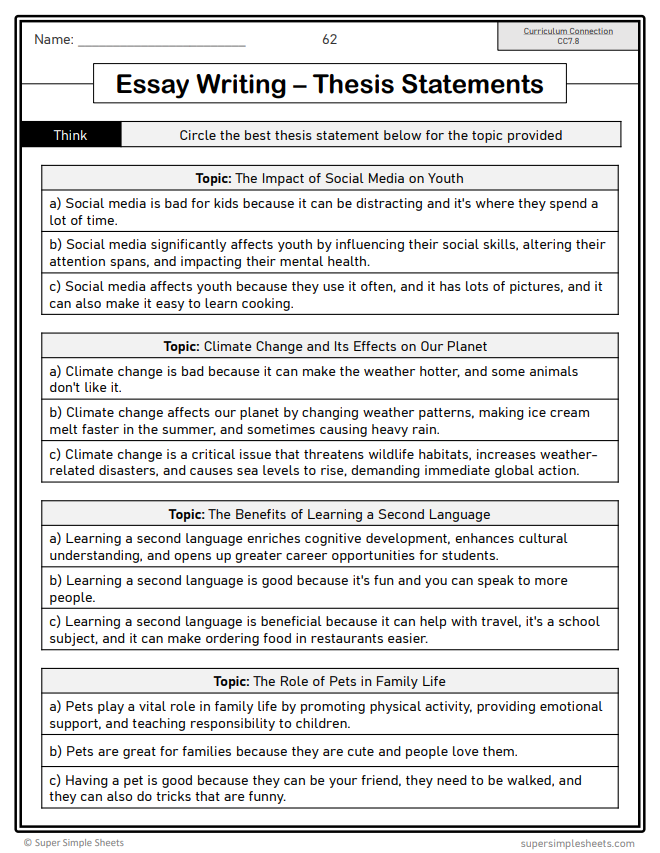
- Essay writing – how to write a thesis statement
- Writing a 5-paragraph essay
- Formal versus informal letter writing – voice in our writing
- Narrative writing – beginning, middle, end
- Narrative structure – exposition, rising action, climax, falling action, resolution
- Plots and subplots
- Adding suspense, foreshadowing, and exaggeration (hyperbole) to stories
- Analyzing quality stories – building success criteria
- Using quotations in narrative writing – dialogue
- Characterization – creating funny, mysterious, fantasy, and adventurous characters
- Character development – describe how characters change over time due to big events
- Revision – using paragraphs appropriately and eliminating unnecessary repetition of words and ideas
- Activity – Story Swap Revision
- Understanding persuasive writing
- Activity – Being Persuasive: Debate
- Understanding bias in persuasive writing
- Assignment – advertising a new invention
- Collecting data by completing a survey to enhance a persuasive argument
- Expository text forms – reports, lists, problem/solution report, compare/contrast essay, cause and effect essay
- Writing a How-To-Guide
- Multimedia how-to-guide: taking pictures to represent and support text in a how-to-guide
- Synthesizing multiple reports
- Writing a report – different types of bears and the importance of bees
- How to research effectively – trustworthy sources, using keywords
- Activity – Online Treasure Hunt
- Writing a problem/solution report
- Determining solutions to problems
- Types of poems – Haiku, Limerick, Rhyming Poems, Acrostic Poems
- Assignment – writing a poetry children’s book
- Comic strips – onomatopoeia and illustrating graphic texts
- Assignment - creating an online comic strip
- Biographies – cross curricular connections: Louis Riel, Leif Erikson, and Laura Secord
- How to cite where we find research – bibliography
- Activity – Partner Biography/Bibliography Assignment
- Reconstructing texts – translating texts from one form to another – e.g., letter to news report, infographic to story
- Inquiry group project – working collaboratively to choose a topic and formulate questions to guide their research
- Cursive writing package/booklet
- Answer pages for all activities
Google Lesson Slides
Grade 7 - Writing Unit - Google Lesson Slides - Saskatchewan Language Curriculum. This resource is packed with all the lessons you need to teach the Writing, Grade 7, Saskatchewan Language Curriculum.
We have structured these lessons to follow the popular 3-Part Lesson format. By using these lessons, you will be provided with learning goals, discussion questions, relevant YouTube videos, interactive slides, exit cards, and more. Check out the variety of activities you'll receive below.
Part 1: Minds On!
- Learning Goals
- Discussion Questions
- Quotes
Part 2: Action!
- Interactive Activities
- Drag and Drop
- Fill in the Blanks
- Matching
- Drawing
- Writing
Part 3: Consolidation
- Exit Cards
- Quizzes
- Reflection
After purchasing this resource, you will be able to download a copy of this file to your Google Drive. From there, you can complete these lessons with your class, and/or assign these slides in Google Classroom.