

Grade 8 - Cells - Ontario Science - Workbook
Grade 8 - Cells - Ontario Science - Workbook
Regular price
$10.00 CAD
Regular price
Price
$14.00 CAD
Sale price
$10.00 CAD
Save $4.00 CAD
Unit price
per
Interested in a bundle? Shop below instead!
Couldn't load pickup availability
Ontario Grade 8 Science – Cells Unit – Workbook. A no-prep, 159-page workbook that covers every expectation in the Cells strand of the Ontario Science Curriculum, updated in 2026 with Strand A: STEM and coding included.
What you get
- Printable PDF workbook: 159 pages of readings, questions, experiments, hands-on activities and exit cards.
- Google Slides version: a link inside the PDF makes your own copy to assign in Google Classroom.
- Unit test and answer pages for all activities.
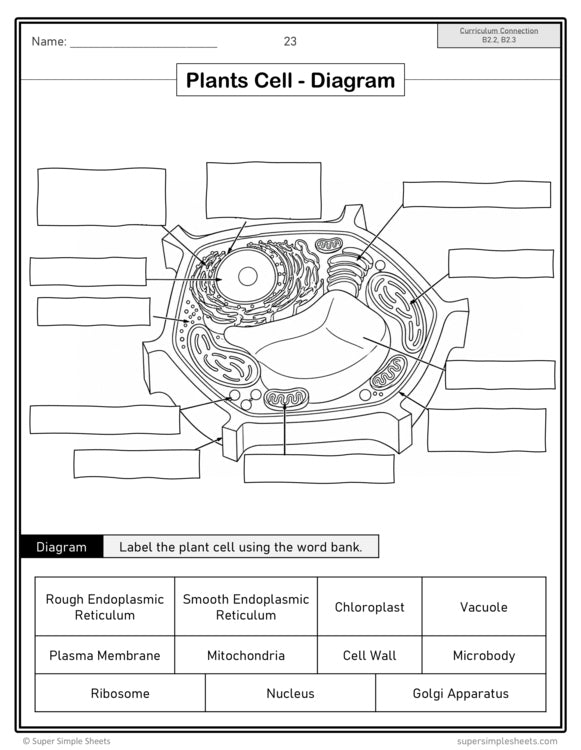
Topics include: What is a cell?, Cell theory, Importance of a microscope – understanding the function of each part, Microscope diagram – labelling activity, Organelles in cells – nucleus, cell membrane, cytoplasm, cell wall, mitochondria and more, Diagrams of plant and animal cells, and more.
Want the matching Google Lesson Slides too? Get the Lessons + Workbook Bundle for this unit.
Full list of topics covered
- What is a cell?
- Cell theory
- Importance of a microscope – understanding the function of each part
- Microscope diagram – labelling activity
- Organelles in cells – nucleus, cell membrane, cytoplasm, cell wall, mitochondria and more
- Research assignment – organelle in plant and animal cells
- Diagrams of plant and animal cells
- Comparing plant and animal cells – structure, organelles, size, shape
- Identifying plant and animal cells
- Experiment/activity – building a 3D model of a cell
- Diffusion of molecules in cells
- Osmosis in cells
- Factors affecting diffusion
- Diffusion and the exchange of gas in humans and frogs
- Solutions, solutes, and solvents
- Ideal solutions for cells – osmosis
- Unicellular organisms – Amoeba and Paramecium
- Research assignment – studying unicellular organisms
- Multicellular organisms – humans, worms, and frogs
- Levels of organization – cells, tissues, organs, and organ systems
- Researching organ systems to learn about the organs, tissues, and cells included
- Technologies in cell biology – electron microscopes
- Stem cell technologies treating disease – Alzheimer's and Spinal injuries
- Researching advantages and disadvantages of stem cells
- Cellular agriculture – cultured meat
- Using cultured meats – multiple perspectives (animals, environmentalists, livestock farmers)
- STEM Activities
- Hands on Experiments – making a cell model, demonstrating osmosis and diffusion, and examining an onion using a microscope
- Reading and writing code related to cell biology
- STEM Assignment – Inventing a cell testing machine using coding and robotics
- Unit test
- Answer pages for all activities
Which format is right for you?
- Workbook – worksheets, activities, exit cards, a unit test and answer pages for one unit.(This listing.)
- Lesson Slides – Google Slides lessons that match the workbook for one unit.
- Lessons + Workbook Bundle – the lesson slides and the workbook for one unit.
- Lesson Bundle – all the lesson slides for one grade and subject.
- Full Year Bundle – all the workbooks for one grade and subject.
- Mega Bundle – all the lesson slides and all the workbooks for one grade and subject.