

Grade 8 - Reading Comprehension - Ontario Language - Workbook
Grade 8 - Reading Comprehension - Ontario Language - Workbook
Regular price
$24.00 CAD
Regular price
Price
$33.00 CAD
Sale price
$24.00 CAD
Save $9.00 CAD
Unit price
per
Interested in a bundle? Shop below instead!
Couldn't load pickup availability
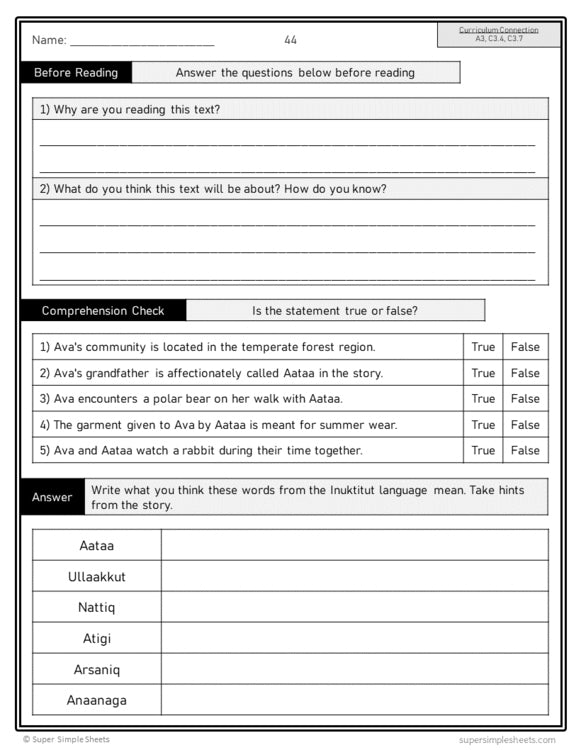
Ontario Grade 8 Language – Reading Comprehension Unit – Workbook. A no-prep, 318-page workbook that covers every expectation in Strand C, Reading Comprehension, of the Ontario Language Curriculum (2023).
What you get
- Printable PDF workbook: 318 pages of reading passages, comprehension questions and activities across 10 text forms.
- Google Slides version: a link inside the PDF makes your own copy to assign in Google Classroom.
- Answer pages for all activities.
Topics include: What is reading comprehension? What strategies work for me; Cultural text forms – creation stories and songs; Bias in letter writing, book reviews, and in persuasive writing; Making inferences from letter writing; Sequencing a narrative with multiple plots – rearranging plot events, and more.
Want the matching Google Lesson Slides too? Get the Lessons + Workbook Bundle for this unit.
Full list of topics covered
- What is reading comprehension? What strategies work for me?
- Before reading: comprehension strategies – activating prior knowledge and reasons for reading
- During reading: comprehension strategies – questioning, making connections, inferences, predictions, visualizing
- After reading: comprehension strategies – summarizing, inferences, synthesizing, evaluating, visualizing
- Cultural text forms – creation stories and songs
- Indigenous Storywork – 7 Principles: respect, responsibility, reciprocity, reverence, holism, interrelatedness, synergy
- Indigenous storytelling – norms, values, hierarchy, past times, language, taboos
- Cross-curricular connections – text forms related to themes in science and social studies (cells, water systems, etc.)
- Adjusting reading rates: Learning to read at different speeds based on the text's difficulty
- Bias in letter writing, book reviews, and in persuasive writing
- Making inferences from letter writing
- Narratives – finding examples of literary devices: irony, allusion, and satire
- Sequencing a narrative with multiple plots – rearranging plot events
- Determining the causes and effects in narratives
- Implicit versus explicit evidence in persuasive texts
- Expository texts – informational reports and how-to-guides
- Text patterns in cause-and-effect essays, problem-and-solution reports, five-paragraph essays, compare and contrast essays
- Text patterns in blog posts
- Synthesizing multiple reports and essays
- Five paragraph essays – text patterns and features
- Problem and solution letters
- Identifying thesis statements found in reports and essays
- Identifying literary devices in poetry – irony, allusion, and satire
- Analyzing poems – haiku, limerick, acrostic, cinquain, and rhyming poetry
- Studying poetry written by Indigenous authors
- Explicit and implicit perspectives in book reviews
- Activity – detecting bias in online reviews
- Graphic texts – timelines, memes, comics, infographics, maps
- Biographies – Samuel de Champlain, Tom Longboat, Alexander Graham Bell, Joan Chalmers, Norval Morrisseau
- Answer pages for all activities
Which format is right for you?
- Workbook – worksheets, activities, exit cards, a unit test and answer pages for one unit.(This listing.)
- Lesson Slides – Google Slides lessons that match the workbook for one unit.
- Lessons + Workbook Bundle – the lesson slides and the workbook for one unit.
- Lesson Bundle – all the lesson slides for one grade and subject.
- Full Year Bundle – all the workbooks for one grade and subject.
- Mega Bundle – all the lesson slides and all the workbooks for one grade and subject.