
Grade 9 - Alberta Language Arts ELA - FULL YEAR BUNDLE
Grade 9 - Alberta Language Arts ELA - FULL YEAR BUNDLE
Interested in a bundle? Shop below instead!
Couldn't load pickup availability
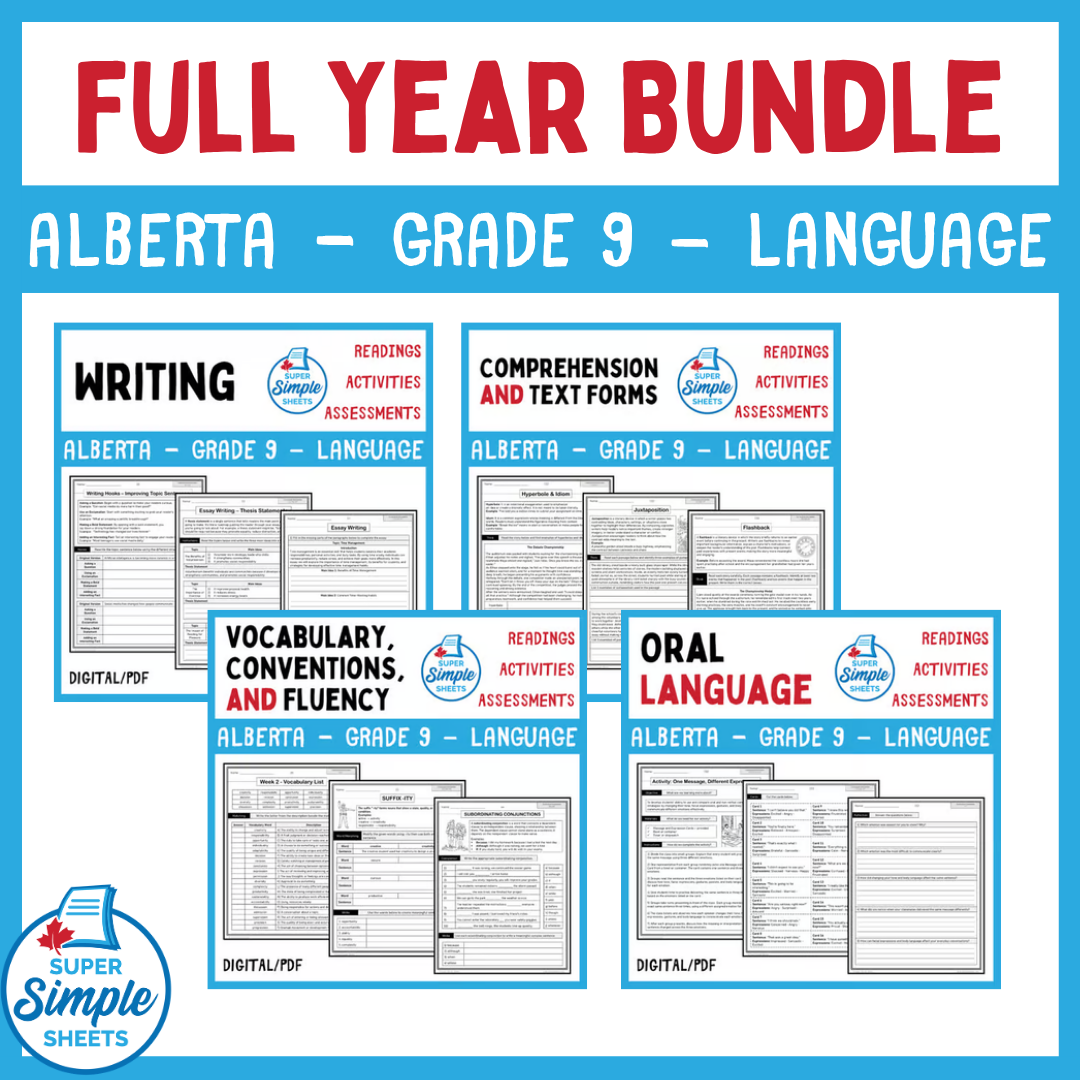
Grade 9 - Alberta Language Arts ELA - FULL YEAR BUNDLE - Teaching made easy! This NO PREP bundle includes everything you need to teach the Alberta Grade 9 Language Arts (ELA) Curriculum.
Grade 9 - Alberta Language Curriculum – Vocabulary, Conventions, and Fluency
Included in this resource are the General Outcomes below:
- General Outcome 2: Students will listen, speak, read, write, view and represent to comprehend and respond personally and critically to oral, print and other media texts.
- General Outcome 4: Students will listen, speak, read, write, view and represent to enhance the clarity and artistry of communication.
Some of the concepts covered:
- Suffixes: -ing, -ly, -able, -less, -ment, -ful, -ness, -tion, -ous, -y, -ize, -ship and many more
- Prefixes: un-, re-, dis-, pre-, ex-, in-, non-, sub-, inter-, anti-, mis-, super- and many more
- Sentence Structure: Sentence Fragments, Run-On Sentences, Simple, Compound, Complex, and Compound-Complex Sentences
- Clauses and Conjunctions: Independent and Dependent Clauses, Relative Clauses, Adverbial Clauses, Prepositional Clauses, Coordinating, Subordinating, and Correlative Conjunctions
- Parts of Speech: Nouns, Pronouns, Verbs, Adjectives, Adverbs, Prepositions, and Conjunctions
- Verb Forms and Tenses: Linking Verbs, "To Be" Verbs, Past, Present, Future, and Perfect Tenses
- Commands and Questions: Imperative and Interrogative Verbs
- Pronouns: Relative, Intensive, and Reflexive Pronouns
- Sentence Components: Direct Objects, Indirect Objects, Predicate Nouns, and Predicate Adjectives
- Verbals: Gerunds and Participles
- Adverbs and Phrases: Adverbial Phrases and Prepositional Phrases
- Voice in Writing: Active and Passive Voice, and Choosing the Appropriate Voice
- Capitalization: Proper Adjectives, Dialogue, Titles, and Formal Writing
- Punctuation: Quotation Marks, Commas, Colons, Semicolons, Ellipses, and Dashes
- Reading Fluency: Expression, Intonation, and Reading for Purpose and Audience
- Vocabulary Development: Weekly Tier 2 and Tier 3 Vocabulary, Morphology, Prefixes, Suffixes, and Word Analysis
- Reader's Theatre: Developing Reading Fluency, Expression, Comprehension, and Oral Communication Skills
- Weekly quizzes (30 different assessments)
- Answer pages for all activities
Grade 9 - Alberta Language Curriculum – Writing Workbook
Included in this resource are the General Outcomes below:
General Outcome 2: Students will listen, speak, read, write, view and represent to comprehend and respond personally and critically to oral, print and other media texts.
General Outcome 3: Students will listen, speak, read, write, view and represent to manage ideas and information.
General Outcome 4: Students will listen, speak, read, write, view and represent to enhance the clarity and artistry of communication.
General Outcome 5: Students will listen, speak, read, write, view and represent to respect, support and collaborate with others
Some of the concepts covered:
- Types of text forms – when to use each one (narratives, letters/emails, persuasive, comic strips, reports, etc.)
- Experiment – writing with planning time versus writing without planning time (no brainstorming)
- Activity – Voice in Music
- Personal voice in writing
- How to write a perfect paragraph – topic sentence (hook), body (supporting details), conclusion
- Essay writing – how to write and identify a thesis statement
- Writing a 5-paragraph essay
- Formal versus informal letter writing – voice in our writing
- Narrative writing – beginning, middle, end
- Analyzing quality stories – building success criteria
- Using quotations in narrative writing – dialogue
- Activity – Story Swap Revision
- Understanding persuasive writing
- Activity – Being Persuasive: Debate
- Understanding bias in persuasive writing
- Assignment – advertising a new invention
- Expository text forms – reports, lists, problem/solution report, compare/contrast essay, cause and effect essay
- Writing a How-To-Guide
- Synthesizing multiple reports
- Writing a report – circulatory system and water bodies
- How to research effectively – trustworthy sources, using keywords
- Activity – Online Treasure Hunt
- Writing a problem/solution report
- Determining solutions to problems
- Types of poems – Haiku, Limerick, Rhyming Poems, Acrostic Poems
- Assignment – writing a poetry children’s book
- Cursive writing – Limerick
- Comic strips – onomatopoeia and illustrating graphic texts
- Assignment - creating an online comic strip
- Biographies – cross curricular connections: Marie Curie, John A. Macdonald, and Tecumseh
- How to cite where we find research – bibliography
- Activity – Partner Biography/Bibliography Assignment
- Cursive writing package/booklet
- Answer pages for all activities
Grade 9 - Alberta Language Curriculum – Comprehension and Text Forms Workbook
Included in this resource are the General Outcomes below:
General Outcome 1: Students will listen, speak, read, write, view and represent to explore thoughts, ideas, feelings and
experiences.
General Outcome 2: Students will listen, speak, read, write, view and represent to comprehend and respond personally
and critically to oral, print and other media texts.
General Outcome 5: Students will listen, speak, read, write, view and represent to respect, support and collaborate with
Others
Some of the concepts covered:
- How techniques like word choice, fonts, and layouts affect texts
- What is reading comprehension? What strategies work for me?
- Comprehension Practice – Refocusing / Re-engaging
- Bias in letter writing, book reviews, and in persuasive writing
- Making inferences from letter writing
- Narratives – finding examples of literary devices: irony, allusion, and satire
- Analyzing first-person, second-person, and third-person narratives
- Analyze the decision making of characters
- Drama stories – round and flat characters
- Sequencing a narrative with multiple plots – rearranging plot events
- Narrative structure – exposition, rising action, climax, falling action, resolution
- Story structures: linear, cyclical, and iterative stories
- Story – Character Identification And Comparison
- Characterization – character traits, decision making, and evolution of characters
- Cultural Stories: African Nova Scotians, Acadians, the Mi'kmaq Nation
- Determining the causes and effects in narratives
- Implicit versus explicit evidence in persuasive texts
- Expository texts – informational reports and how-to-guides
- Propaganda – Critical Analysis
- Synthesizing multiple reports and essays
- Identity, Social Responsibility And Efficacy
- Scanning texts looking for specific information for research
- Analyzing a speech – Stereotypes in Indigenous Culture
- Study strategy: read, recite, and review
- Five paragraph essays – text patterns and features
- Identifying thesis statements found in reports and essays
- Identifying literary devices in poetry – irony, hyperbole, simile, metaphor, allusion, and satire
- Analyzing poems – haiku, limerick, acrostic, cinquain, and rhyming poetry
- Studying poetry written by Indigenous authors
- Explicit and implicit perspectives in book reviews
- Activity – detecting bias in online reviews
- Book review – choose favourite author and compare the texts they have written
- Graphic texts – timelines, memes, comics, infographics, maps
- Visual/graphics – Illustration styles: realism, cartoon, sketch, outline
- Biographies – Samuel de Champlain, Tom Longboat, Alexander Graham Bell, Joan Chalmers, Norval Morrisseau
- Activity: analyzing multimedia features (bold fonts, visuals, layout, music, colours, etc.)
- Answer pages for all activities
Grade 9 – Alberta English Language Arts Curriculum (ELA) – Oral Language Unit
Some of the concepts covered:
- Activity: Interactive Q&A Sessions
- Activity: Open-Ended Question Challenge
- Activity: Idea Gallery Walk
- Activity: Feedback Circle
- Activity: Presentation Rehearsals with Peer Feedback
- Activity: Two Truths and a Lie - Listening Edition
- Activity: Listening Journal Reflection
- Activity: Audio Story Analysis
- Activity: Perspective Exchange Discussions
- Activity: Respectful Response Role-Play
- Activity: Perspective Shift Debate
- Activity: The Conversation Web
- Activity: Vocabulary Scavenger Hunt
- Activity: Pass the Story
- Activity: Discussion Circles
- Activity: The Social Justice Web
- Activity: Audience Analysis
- Activity: Story Circle and Response Chains
- Activity: Group Discussion Leaders
- Activity: Story Circle Paraphrase
- Activity: Guest Speaker Analysis
- Activity: Grammar and Syntax Workshop
- Activity: Role-Playing Scenarios
- Activity: Impromptu Speeches
- Activity: Opinion Beach Ball
- Activity: Community Helpers and Their Challenges
- Activity: Readers' Theatre - Poetry Performance
- Activity: Mood Mirroring
- Activity: Emotion Waves
- Activity: Nonverbal Communication Game
- Activity: Emotion Charades
- Activity: Cultural Communication Exploration
- Activity: Feedback Incorporating Activity
- Activity: Classroom Teach-Back
- Activity: Collaborative Mind Maps
- Activity: Presentation Breakdown
- Activity: Targeted Presentation Project
- Activity: Debate Club
- Activity: The Great Debate
- Activity: Media Detective
- Activity: Culture Café
- Activity: The Oral Communication Awards
This is a comprehensive bundle that will save you hours of planning! It has everything you need to feel confident that you are covering the Alberta Language Arts curriculum.
BOTH GOOGLE SLIDES AND PDF VERSIONS INCLUDED!